Visualizzazione post con etichetta Messico. Mostra tutti i post

lunedì 14 maggio 2018

Genova

La seconda giornata che ho passato a Genova, ospite della mia amica RagazzAcidella è cominciata con una brioche al cioccolato bianco in un baretto sul mare. Genova segna punti rispetto a Milano, ma mi consolo pensando che almeno la mia città ha tantissimi ristoranti etnici buonissimi.

The second day I spent in Genoa, guest of my friend RagazzAcidella, started with a white chocolate croissant in a small bar on the sea. Genoa scores points compared to Milan, but I comfort myself thinking that at least my city has plenty of very good ethnic restaurants.

E invece anche su questo subisco una sconfitta umiliante. RagazzAcidella mi ha portato nel ristorante messicano più buono in cui io sia stata in Italia, Mamacita's, in via Fieschi 78r, nei vicoletti di Genova un po' malfamati di cui cantava De Andrè, dove ho ritrovato i sapori del mio viaggio in Messico.
L'interno ha pareti, piastrelle, piatti, bandiere, lampade e oggetti coloratissimi.

But on this, too, I suffer a humiliating defeat. RagazzAcidella took me to the best Mexican restaurant I ate to in Italy, Mamacita's, in via Fieschi 78r, in the somewhat dodgy streets of Genoa of which sang De Andrè, where I rediscovered the flavors of my trip to Mexico.
The interior has colorful walls, tiles, plates, flags, lamps and objects.

Il menù è una sorpresa sia per la varietà sia per i prezzi ridicolmente bassi. Abbiamo preso nachos (quelli veri!) con guacamole, ci siamo divise una quesadillas gigante servita con cinque salse diverse, abbiamo preso un burrito ai fagioli e ben due tacos chorizo queso che erano buoni da svenire e ci hanno portato anche ulteriori fagioli con nachos. Da bere abbiamo diviso una caraffa di sangria.
Abbiamo concluso con il cafe de cholla, leggero, speziato e servito in vasellame di terracotta e ci è stato anche offerta una tequila fantastica.
Mangiando come dei maiali abbiamo speso meno di 15€ a testa!
Credo che andrò in pellegrinaggio a Genova solo per tornarci.

The menu is a surprise both for the variety and for the ridiculously low prices. We ate nachos (the real ones!) with guacamole, a giant quesadillas served with five different sauces, a bean burrito and two queso chorizo ​​tacos that were breathtakingly good and more beans with nachos. We also shared a carafe of sangria to drink.
We ended with cafe de cholla, light, spicy and served in earthenware pots and we were also offered a fantastic tequila.
Eating like pigs we spent less than 15€ each!
I think I will go back to Genoa on a pilgrimage just to eat there again.
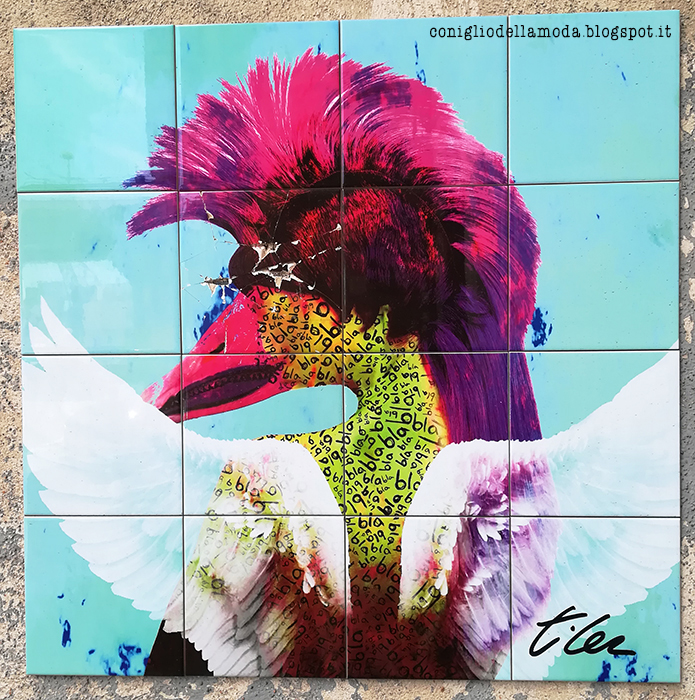
Il pomeriggio abbiamo fatto un giro in centro città. Ho osservato diversi lavori a piastrelle, quelli più tradizionali e quelli dello street artist genovese Tiler.

In the afternoon strolled in the city center. I saw different tile works, more traditional ones and those of the Genoese street artist Tiler.

Sono anche finalmente riuscita ad entrare nella cattedrale di San Lorenzo. Mi hanno colpito soprattutto l'affresco della controfacciata (XIV secolo), l'affresco di Lazzaro Tavarone con l'ultima cena nella navata destra e, soprattutto, la bomba che ha colpito la cattedrale durante la seconda guerra mondiale, senza esplodere.

I also finally managed to enter the San Lorenzo cathedral. I was particularly struck by the fresco of the counter-façade (14th century), the fresco by Lazzaro Tavarone with the last supper in the right aisle and, above all, the bomb that hit the cathedral during the Second World War, without exploding.

Durante il mio giro di shopping ho comprato una maschera viso bio al cioccolato e fango della 7th Heaven (2€ circa). Il profumo è ottimo e con una bustina ho fatto due applicazioni (ma con un dosaggio più mirato sarei riuscita a farne almeno una terza). Dopo averla usata ho sentito la pelle un po' più morbida, ma non ho notato altri benefici particolari.
Nello stesso negozio ho comprato per 5€ circa una manopola depilatoria con vari foglietti perché mi servivano i ricambi per la mia e non erano in vendita senza manopola.
In un negozietto etnico ho comprato delle lungta, le bandiere da preghiera tibetane. Poi ho visto nella vetrina di una merceria dei bottoni coloratissimi a forma di coniglietto e li ho assolutamente voluti (1€ ciascuno).
L'acquisto forse più bello, ma meno tipico è stato un paio di orecchini color ottanio con le nappine da Bershka (8€).

During my shopping trip I bought a 7th Heaven organic chocolate and mud face mask (around 2€). The perfume is great and with a bag I did two applications (but with a more calculated dosage I would have managed to do at least a third). After using it I felt my skin a little softer, but I did not notice any other special benefits.
In the same store I bought for about 5€ a depilatory mitten with various sandpaper sheets because I needed spare sheets for mine and they were not for sale without the mitten.
In an ethnic shop I bought lungta, Tibetan prayer flags. Then I saw in the window of a haberdashery colorful bunny buttons and I absolutely wanted them (€ 1 each).
Perhaps the most beautiful, but less typical, purchase was a pair of teal-colored earrings with tassels by Bershka (8€).

Come souvenir per la mia Pelosa Metà, prima di partire ho comprato il pesto della Novella e la focaccia della panetteria "Da Mario" in Salita S. Paolo 28.
I weekend con RagazzAcidella sono sempre fantastici, non vedo l'ora di ripetere!

As a souvenir for my Hairy Half, before leaving I bought pesto by Novella the focaccia of the bakery "Da Mario" in Salita S. Paolo 28.
The weekends with RagazzAcidella are always fantastic, I can not wait to have another one!

martedì 16 gennaio 2018

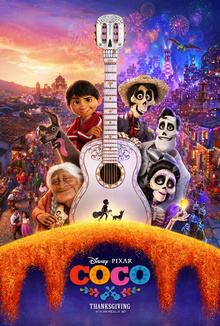
Coco

"Coco" è un film Pixar del 2017diretto da Lee Unkrich e Adrian Molina.
E' ambientato in Messico. Il protagonista è Miguel, ragazzino che vorrebbe diventare musicista contrariamente ai desideri della famiglia, che odia la musica perché la trisavola era stata abbandonata proprio da un musicista. Ma nel Dia de los Muertos tutti i nodi vengono al pettine.
I temi del film sono la musica, la famiglia... e la morte. O meglio, il ricordo dei propri morti. Non proprio un tema tipico di un cartone animato occidentale per bambini, anche se la Pixar aveva ne aveva già affrontati di altrettanto difficili (per esempio all'inizio di "Up").  Il film ha materiale per commuovere quasi chiunque: padri assenti, passioni ostacolate dalle famiglie, nonnine fragili e smemorate, amori perduti. E il lato migliore è che la carica emotiva viene intensificata dall'età: gli adulti, che hanno già perso qualcuno, la sentono ben più dei bambini. Il rischio di trasformare il tutto in un melodramma era fortissimo. Nonostante questo, in "Coco" i sentimenti non sono mai forzati. Ci sono anche vari momenti divertenti (il personaggio del cane, poi, è uno spasso) e, con la scusa della musica, le canzoni sono inserite organicamente nel contesto.
Il character design è variato e interessante, ma a livello visivo il punto forte è il coloratissimo mondo dei morti.
In definitiva è un film davvero molto bello, da vedere.

"Coco" is a 2017 Pixar movie directed by Lee Unkrich and Adrian Molina.
It is set in Mexico. The protagonist is Miguel, a boy who would like to become a musician against the wishes of his family, who hates music because the great-great-grandmother was abandoned by a musician. But in the Dia de los Muertos all chickens come home to roost.
The themes of the movie are music, family... and death. Or rather, the memory of our dead. Not really a typical theme of a western animated movie for children, even if Pixar already dealt with difficult ones (for example at the beginning of "Up"). The movie has material to move almost anyone: absent fathers, passions hindered by families, fragile and forgetful grandmothers, lost loves. And the best part is that the emotional charge is intensified by age: the adults, who have already lost someone, feel it much more than the children. The risk of turning everything into a melodrama was very high. Despite this, in "Coco" feelings are never forced. There are also various amusing moments (the dog character, is really funny) and, with the excuse of the music, the songs are organically inserted into the context.
The character design is varied and interesting, but visually the strong point is the colorful world of the dead.
Ultimately it is a really beautiful movie, I recommend it.

martedì 2 febbraio 2016

Mexican food (LIDL)

Il LIDL ha dedicato settimana scorsa al cibo messicano, così ho fatto qualche acquisto: un taco dinner kit a 2,30€, due mix di spezie, uno per chili con carne e uno per quesadilla, a 60 cent l'uno, tre pacchetti di cheddar al peperoncino a 1,75€, e un barattolo di fagioli neri a 50 cent, tutti di marca El Tequito.
Il taco dinner kit contiene 12 conchiglie di mais, una salsa per taco e un mix di spezie per tacos. Non ha ingredienti incredibili. Per il resto non posso dire niente perché l'ho regalato.
Gli ingredienti dei mix di spezie sono quasi completamente naturali. Hanno il classico aroma che si associa al cibo messicano. Li ho trovati molto buoni. Il problema è che, nonostante gli ingredienti in parte diversi (mi attiravano molto la polvere di cacao e di buccia d'arancia del mix per quesadillas), i due mix sono praticamente identici.
Il cheddar è una bomba. E' proprio il tipo di cheddar che adoro a livello di stagionatura, stagionato e farinoso, che si scioglie che è un piacere, e l'aggiunta di peperoncino ci sta davvero bene. Attenzione però perché è molto pesante, non bisogna esagerare con le dosi.
I fagioli neri non sono niente di incredibile. Li ho provati con le spezie per chili che ci stavano molto bene.

Last week LIDL had some Mexican food, so I made some purchases: a taco dinner kit for 2.30€, two spices mixes, one for chili con carne and one for quesadillas, for 60 cents each, three packets of hot chili cheddar for 1.75€, and a can of beans blacks for 50 cents, all by El Tequito.
The taco dinner kit contains 12 corn shells, a taco sauce and a mix of spices for tacos. It has not incredible ingredients. For the rest I can not say anything because I used it as a present.
The ingredients of the spice mix are almost completely natural. They have the classic aroma associated with Mexican food. I found them very good. The problem is that, despite many ingredients  are different (I loved the idea of the cocoa powder and orange peel in the quesadillas mix), the two have virtually identical scents.
The cheddar is a bomb. It's just the kind of cheddar that I love, seasoned and chalky, that melts easily, and the addition of chili fits it really well. But be careful because it is very heavy, it's better to avoid eating too much.
The black beans are nothing incredible. I tried them with the chili spices mix that fit them really well.

venerdì 22 gennaio 2016

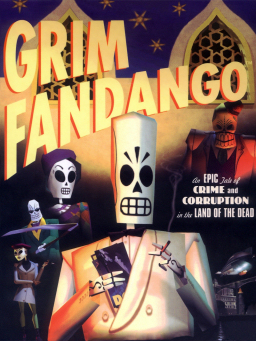
Grim Fandango

A movie poster-style depiction of several film noir style characters whose appearance is that of stylised skeletons.
"Grim Fandango" è un'avventura grafica del 1998 sviluppata e prodotta dalla Lucas Arts. Tim Schafer, il capo del progetto, aveva lavorato anche ad un altro gioco vintage famosissimo, Day of the Tentacle.
È stata la prima avventura della Lucas Arts a utilizzare grafica tridimensionale. Io ho giocato il remake del 2014, che non ha una grafica incredibile, ma comunque si suppone migliore dell'originale. La nuova versione del titolo è disponibile su PlayStation 4, PlayStation Vita, Microsoft Windows, Mac OS X, e Linux.
Il gioco è ambientato in un aldilà ispirato a quello atzeco, secondo cui le anime devono attraversare la Terra dei Morti prima di raggiungere la loro vera destinazione, il Nono Aldilà. Il protagonista, Manuel Calavera, è un agente di viaggi del Dipartimento della Morte, il cui compito è vendere alle anime i pacchetti di viaggio che si sono guadagnati con le azioni compiute in vita. Il mezzo più ambito è il Numero Nove, un treno che fa il viaggio  che normalmente dura quattro anni in quattro minuti. Finalmente Manny trova Mercedes Colomar, una donna che ha condotto una vita esemplare e quindi si merita il biglietto per il Numero Nove. Con la commissione della vendita, potrebbe finalmente saldare il suo debito e lasciare il mondo dei morti. Ma il biglietto che spetterebbe a Mercedes non si trova... è solo la punta dell'iceberg di una cospirazione che coinvolge tutta la Terra dei Morti e che trascinerà Manuel in una serie di avventure sempre più pericolose.
Come in molti giochi della Lucas Art, c'è una notevole dose di ironia, anche se meno che in giochi come Monkey Island.
La trama è suddivisa in quattro capitoli, ognuno ambientato il Giorno dei Morti, ad un anno di distanza l'uno dall'altro.
Come nella maggior parte delle avventure grafiche della LucasArts, il giocatore non può mai morire o comunque entrare in una situazione senza possibilità di vittoria. Tuttavia alcuni puzzle sono molto fastidiosi perché sono difficili da capire e  alcune soluzioni che non sono logiche anche dopo averle individuate. Per esempio in un paio di casi bisogna passare sopra al punto giusto in un'area piuttosto estesa. Ammetto che varie volte sono ricorsa all'aiuto di suggerimenti trovati online.
Secondo me la parte migliore del gioco sono le ambientazioni, che prendono spunto dalla mitologia atzeca e maya, dal Dia del Los Muertos messicano, soprattutto nei personaggi, e dal liberty. Sono stupende anche le musiche, dal tono noir, soprattutto quelle più jazz.
Nonostante i punti deboli lo consiglio assolutamente, la storia, l'ambientazione, l'ironia e le musiche giustificano perfino l'astrusità di alcuni enigmi (anche perché nel caso in cui ci si stufasse è piuttosto semplice trovare le soluzioni online).

"Grim Fandango" is a 1998 adventure game developed and produced by Lucas Arts. Tim Schafer, the head of the project, also worked to another famous vintage game, Day of the Tentacle.
It was the first adventure game by LucasArts to use three-dimensional graphics. I played the 2014 remake, which hasn't a such amazing graphics, but is supposedly better than the original. The new version of the title is available on PlayStation 4, PlayStation Vita, Microsoft Windows, Mac OS X, and Linux.
The game is set in an afterlife inspired by the Aztec tradition, according to wich the souls must cross the Land of the Dead before reaching their true destination, the Ninth Afterlife. The protagonist, Manuel Calavera, is a travel agent of the Department of Death, whose job is to sell to the souls the travel packages that they earned with their actions in life. The most coveted is Number Nine, a train that makes the trip, that normally takes four years, in four minutes. Manny finally finds Mercedes Colomar, a woman who led an exemplary life and therefore deserves the ticket for the Number Nine. With the commission of the sale, he could finally pay off his debt and leave the world of the dead. But Mercedes' ticket is nowhere to be found... it is only the tip of the iceberg of a conspiracy involving the entire Land of the Dead, that will drag Manuel in a series of increasingly dangerous adventures.
As with many games of Lucas Art, there is a great deal of irony, though less than in games like Monkey Island.
The plot is divided into four chapters, each set the Day of the Dead, a year apart.
As most LucasArts adventure games, the player can never die or enter a no-win situation. However some puzzles are very annoying because they are difficult to understand and some things are not logical even after solving them. For example, in a couple of cases you have pass on to the right place in a rather large area. I admit that many times I searced tips online.
I think the best part of the game are the settings, which are inspired by the Aztec and Mayan mythology, the Mexican Dia Los Muertos, especially for the characters, and liberty for the buildings. The musics are also wonderful, with a noir atmosphere, especially the jazz ones.
Despite the weaknesses I absolutely recommend it because the story, the setting, the irony and the music justify the obscurity of some puzzles (also because if you get bored by them is quite simple to find the solutions online).

mercoledì 28 ottobre 2015

The book of life


"The book of life" è un film animato in 3D del 2014 prodotto dalla Reel FX Creative Studios (e fra gli altri da Guillermo del Toro).
Si basa sulle leggende popolari messicane legate alla morte. Due divinità del mondo dei morti, quella dei morti ricordati e quella dei morti dimenticati, incontrano tre bambini, Manolo, Joaquín e Maria, e decidono di scommettere su chi da grande sposerà Maria. Manolo sogna di diventare musicista, ma ha un padre che lo vorrebbe torero, mentre a Joaquín piace combattere.
La trama basata sul triangolo amoroso non è particolarmente originale e si capisce fin dall'inizio come andrà a finire, ma mi è piaciuto molto il rapporto fra i due rivali, come pure quello fra le due divinità. In ogni caso lo svolgimento riesce ad essere avvincente grazie ad un mix di avventura, romanticismo e comicità.
Ci sono anche le classiche parti in stile musical, ma io non vado matta per queste cose.
Le animazioni sono molto ben fatte, anche se non dettagliatissime.
Il comparto visivo è stupendo, coloratissimo e festoso, soprattutto le parti ambientate nel mondo dei morti. L'ambientazione è la parte più originale e interessante del film.
In definitiva è un buon prodotto che fornisce un punto di vista diverso da quello a cui siamo abituati sul mondo dei morti e quindi può essere una visione simpatica per il weekend di Halloween.

"The book of life" is a 2014 3D animated film produced by Reel FX Creative Studios (and among the others, by Guillermo del Toro).
It is based on Mexican folktales related to death. Two gods of the underworld, the one of the remembered dead and the one of the forgotten dead, meet three children, Manolo, Joaquín and Maria, and decide to bet on who will marry Maria as an adult. Manolo dreams of becoming a musician, but has a father who wants him to become a bullfighter, while Joaquín likes to fight.
The plot based on a love triangle is not particularly original and it is clear from the beginning how it will end, but I really liked the relationship between the two rivals, as well as the one between the two gods. In any case, the performance manages engross thanks to a mix of adventure, romance and comedy.
There are also the classic musical-style parts, but I'm not crazy about these things.
The animations are very well done, although not very detailed.
The visual sector is gorgeous, colorful and festive, especially the parts set in the world of the dead. The setting is the most original and interesting side of the film.
Ultimately it is a good product that provides a point of view on the world of the dead different from the one to which we are accustomed and so it can be a nice vision for the Halloween weekend.

giovedì 20 agosto 2015

L'Azteca/Atzec (Colin Falconer)

Dopo quell'allegra trashata di "L'azteco" di Gary Jennings, da brava appassionata di culture precolombiane quest'estate ho letto "L'atzeca" (Atzec), un libro di Colin Falconer, nome di penna dello scrittore australiano Colin Bowles.
"L'atzeca" ricostruisce la conquista dell'impero azteco da parte di Cortes, focalizzandosi sulla figura storicamente ambigua di Malinali, la donna messicana che ne divenne traduttrice e amante aiutandolo nella sua missione.
Le vicende storiche mi sono sembrate ben documentate e ben narrate, ma il vero punto forte del romanzo sono i personaggi, sia quelli storicamente esistiti sia quelli inventati, interessanti e realistici.
Purtroppo la narrazione ha alti e bassi perché, volendo raccontare troppo, non approfondisce molti avvenimenti interessanti e il finale è francamente deludente, lasciato a metà con qualche nota storica come tappabuchi. Soprattutto a causa del finale lo boccio, sono sicura che esistano altri libri più appassionanti sull'argomento.

After the nice trashy novel "The Aztec" by Gary Jennings, as a lover of pre-Columbian cultures this summer I read "The Aztec" (Aztec), a book by Colin Falconer, pen name of the Australian writer Colin Bowles.
"The Aztec" reconstructs the conquest of the Aztec empire by Cortes, focusing on the historically ambiguous figure of Malinali, a Mexican woman who became his translator and lover, helping him in his mission.
The historical events seemed well-documented and well-rehearsed to me, but the real highlight of the novel are the characters, both the historical and the invented ones, that I found interesting and realistic.
Unfortunately the story has ups and downs because, wanting to tell too much, does not analyze many interesting events and the ending is frankly disappointing, left halfway with some historical note as a stopgap. Largely because of the ending, I don't recommend it as I'm sure there are other more exciting books on the subject.

mercoledì 17 giugno 2015

Nuovi gioielli e accessori/New jewels and accessories

Questo weekend ho un matrimonio. Sono molto emozionata perché (per quel che ne so) si sposa la prima mia compagna di classe, ma anche perché è da quando avevo 7 anni che non andavo ad un matrimonio.
Ho già scelto di mettere questo vestito con queste scarpe, quindi dal punto di vista dell'abbigliamento sono tranquilla. Però ho deciso di farmi qualche gioiello intonato. Magari poi non lo metterò, intanto però ho avuto la scusa per usare dei componenti che avevo da parte a prendere polvere e sperimentare con il filo di rame grosso.

This weekend I have a wedding. I am very excited because (as far as I know) it's the first girl in my class to marry, but also because I didn't go to a wedding since I was 7 years old.
I chose to wear this dress with these shoes, so in terms of clothing I am quite relaxed. But I decided to make me some coordinated jewelry. Maybe I won't wear it, but meanwhile I had the excuse to use components that had been collecting dust and experiment with thick copper wire.

Già che c'ero ho deciso di farmi una fascia per capelli con elastico, velluto e la stella marina di pile che avevo fatto l'estate scorsa e poi abbandonato.
Ho anche fatto per mia madre gli orecchini con pon pon rossi che mi aveva chiesto dopo aver visto i miei.

While I was already crafting I decided to make myself a hair band with elastic, velvet and a pile starfish that I made last summer and then abandoned.
I also made my mother the red pom pom earrings she asked me after seeing mine.

Ho anche finalmente trovato la catena giusta per un medaglione che mi hanno portato i miei nonni dal Messico quando ero piccola.

I also finally found the right chain for a medallion that my grandparents brought from Mexico when I was little.

lunedì 1 giugno 2015

Cartagena (Evangelisti)

"Cartagena" è un libro del 2012 di Valerio Evangelisti, scrittore italiano famoso per aver creato il personaggio dell'inquisitore Nicolas Eymerich. E' il terzo di una trilogia dedicata ai pirati, di cui il primo è "Tortuga" (2008) e il secondo "Veracruz" (2009).
Il libro è ambientato nel 1697, 12 anni dopo "Tortuga", che era il secondo in ordine cronologico. Nonostante la distanza temporale incontriamo alcuni personaggi già apparsi nei due romanzi precedenti. Il protagonista è Martin, ufficiale all'interno della spedizione comandata dal barone De Pointis, mandata dal Re Sole a saccheggiare la città di Cartagena, nelle colonie americane della Spagna. Per l'impresa, la flotta francese si unisce a quanto rimane dei Fratelli della Costa, che, pochi anni dopo la conclusione del libro, saranno perseguitati dalle nazioni che in precedenza li avevano sostenuti. L'incontro con i costumi dei pirati e soprattutto con Teresa, moglie di un funzionario spagnolo, sconvolgeranno la vita di Martin, che finalmente sembrava aver preso la direzione giusta dopo una gioventù turbolenta.
Dei protagonisti dei tre libri, Martin è il più umano e il più "morale", ma anche lui è in grado di commettere atrocità senza pensarci due volte, in contesti e maniere che danno il quadro di un'epoca. Mi è piaciuta molto la protagonista femminile, secondo me la migliore del ciclo. Invece mi è spiaciuto un po' non veder riapparire un personaggio femminile misterioso e affascinante che era comparso nei libri precedenti e che avevo l'impressione che sarebbe stato l'elemento che avrebbe connesso i tre romanzi.
Le storie "d'amore" di questi libri si somigliano moltissimo nell'essere il vero motore delle azioni dei protagonisti e nella loro struttura, configurandosi come una sorta di variazione sul tema. Evangelisti affronta i rapporti di genere in una maniera spietata e realistica, che ho adorato in quanto aiuta nella comprensione dei caratteri dei personaggi e soprattutto è perfettamente in armonia con il contesto storico. In questo sono estremamente utili anche i personaggi secondari, caratterizzati benissimo, a cui l'autore si diverte a far raccontare la propria storia per aggiungere spessore all'ambientazione (è un espediente che a volte risulta un po' forzato, ma il risultato è gradevole). 
Di questo ciclo ho apprezzato molto l'intersecarsi e l'influenzarsi reciproco della Storia con la S maiuscola, quella dei libri di scuola, e delle storie dei personaggi che la vivono. Evangelisti per scrivere questa saga si è documentato dettagliatamente: elenca le sue fonti nell'appendice, cosa che mi è piaciuta moltissimo perché rende possibile agli appassionati documentarsi sulle vicende narrate. Molte di queste fonti sono disponibili gratuitamente in rete (anche se la maggior parte sono in francese, sigh!). E' stato grazie ad un link in appendice che ho potuto ascoltare le canzoni piratesche che costellano i libri (ne ho inserita una qui nel post).
In "Cartagena" il narratore è di nuovo onnisciente, con un punto di vista molto vicino, ma non coincidente con il protagonista. Nonostante nel primo libro questa soluzione non mi sia piaciuta, negli ultimi due l'ho apprezzata, a parte un paio di scivoloni (per esempio anche qui, sul finale -ma prima della postfazione, narrata dall' esterno- c'è un cambio incongruo di punto di vista).
Dall'inizio della saga a questo ultimo libro il gusto per lo splatter, per il mio piacere, va diminuendo, anche se non mancano immagini forti.
L'ho trovato un romanzo molto bello, il migliore della saga e il suo giusto culmine.


"Cartagenais a 2012 book by Valerio Evangelisti, an Italian writer known for the character of the inquisitor Nicolas Eymerich. It's the second of a trilogy dedicated to the pirates, following  "Tortuga" (2008) and "Veracruz" (2009).
The book is set in 1697, 12 years after "Tortuga", which was the second in chronological order. Despite the distance in time we meet some characters that appeared in the previous two novels. The protagonist is Martin, an official in the expedition led by Baron De Pointis, sent from the Sun King to sack the city of Cartagena, in Spain's American colonies of. For the feat, the French fleet joins what remains of the Brethren of the Coast, which, a few years after the end of the book, will be persecuted by the nations that previously supported them. The meeting with the pirate costumes and especially with Teresa, wife of a Spanish official, disrupt Martin's life, that finally seemed to have taken the right direction after a turbulent youth.
Of the protagonists of the three books, Martin is the most human and "moral", but he is capable of committing atrocities without thinking twice, in contexts and ways that give the picture of an era. I really liked the female lead, who in my opinion the best of the series. Instead I was a bit displeased not to see again a mysterious and fascinating female character who appeared in the earlier books, and who  I had the impression would be the element connecting the three novels.
The "love" stories of these books are very much alike in being the driving force of the actions of the protagonists and in their structure, so they seem a kind of variation on the theme. Evangelisti describes gender relations in a ruthlessly realistic way, which I loved as it helps in understanding the the characters and above all, it is perfectly fitting with the historical context. To create it, the secondary characters, are extremely useful , as the author has fun to make tell their story to add thickness to the setting (this trick sometimes seems a bit forced, but the result is pleasant ).
Of this saga I enjoyed the intersection and the mutual influence of History with the capital H, the one told in school books, and of the stories of the characters who live it. To write this saga Evangelisti studied that period in detail: in the appendix he lists his sources, a thing I loved because it makes it possible for fans to read up on the events narrated. Many of these sources are available for free on the net (although most are in French, sigh!). It was thanks to a link in Appendix  that I could hear the pirate songs that dot these books (I embedded one here in the post).
In "Cartagena" the narrator is again the omniscient one, with a point of view very close, but not coincident with the protagonist. Although I didn't like this solution in the first book in the last two I came to appreciate it, apart from a couple of slips (for example in this book, in the ending -but before the afterword, narrated from an outer point of view- there is an incongruous change of point of view).
Since the beginning of the series to this last book the taste for splatter, for my pleasure, lessened, although there still are strong images.

I found it a very nice novel, the best of the series and its proper peak.

lunedì 25 maggio 2015

Veracruz (Valerio Evangelisti)

http://www.librimondadori.it/libri/veracruz-valerio-evangelisti
"Veracruz" è un libro del 2009 di Valerio Evangelisti, scrittore italiano famoso per aver creato il personaggio dell'inquisitore Nicolas Eymerich. E' il secondo di una trilogia dedicata ai pirati, di cui il primo è "Tortuga" (2008) , che ho recensito qui, e l'ultimo "Cartagena" (2012).
E' ambientato nel 1683, due anni prima di "Tortuga" e ne condivide la maggior parte dei personaggi. Secondo me dovrebbe essere letto come primo della serie, perché leggendolo per secondo sappiamo già l'esito delle vicende dei vari personaggi e, anche se è comunque gradevole ritrovarli e scoprire il loro passato, si perde l'effetto sorpresa. Certo, c'è un colpo di scena strettamente collegato ad uno dell'altro libro, ma secondo me cambiando l'ordine l'effetto rimane.
Il protagonista è Hubert Macary, secondo ufficiale sulla nave del celebre pirata Laurens de Graaf, soprannominato Lorencillo. Macary non è particolarmente forte o astuto, ma all'interno del disordine della società dei filibustieri è una perla rara per il suo senso della gerarchia e del dovere, derivati da anni passati a combattere come soldato. Macary è la perfetta figura del pirata medio che già si delineava in "Tortuga": sembra una brava persona e si crede tale, ma è in grado di compiere incredibili efferatezze, sia per dovere sia per piacere. Ho trovato questa visione della pirateria poco romantica, ma estremamente realistica e affascinante. Invece non mi ha convinto del tutto la protagonista femminile, che speravo rivelarsi più interessante.
Ho preferito di molto "Veracruz" al libro precedente. Oltre ad essere anch'esso estremamente coinvolgente per le ambientazioni caraibiche e il contesto piratesco, ha un ritmo, un'atmosfera e dei personaggi che mi sono piaciuti di più.
Anche qui troviamo quello che avevo criticato in "Tortuga", ovvero il gusto per le descrizioni splatter (forse un po'meno), e soprattutto il narratore onnisciente che mostra la storia da sopra la spalla del protagonista. In questo caso però non mi ha dato affatto fastidio, perché Macary non è un personaggio ambiguo come Rogerio, ma al contrario segue degli schemi ben definiti e quindi sapere quello che pensa o non saperlo non fa grande differenza.
Questo libro ha un paio di imperfezioni oggettive: la protagonista femminile cambia colore di capelli, dal castano biondiccio della descrizione iniziale al nero, e ci sono due paragrafi molto corti narrati dal punto di vista di un capitano spagnolo abbordato dai pirati che stonano con il resto del libro narrato dal punto di vista di Macary.
In ogni caso, anche se non l'ho trovato un capolavoro, mi è piaciuto e mi ha appassionato. Se avete un debole per i pirati anche voi potrebbe essere una lettura gradevole.

"Veracruz" is a 2009 book by Valerio Evangelisti, an Italian writer known for the character of the inquisitor Nicolas Eymerich. It's the second of a trilogy dedicated to the pirates, following  "Tortuga" (2008), that I reviewed here, and followed by "Cartagena" (2012).
It's set in 1683, two years before "Tortuga" and shares most characters with it. In my opinion it should definitely be read as the first of the series, because reading it as the second you'll already know the outcome of the events and the destiny of the various characters and, although it is still pleasant to read it and discover their past, you lose the surprise element. Sure, there's a twist closely connected to one of the other book, but I think changing the order of the effect remains.
The protagonist is Hubert Macary, second officer on the ship of the famous pirate Laurens de Graaf, nicknamed Lorencillo. Macary is not particularly strong or smart, but in the confusion of the pirate society he is a black swan for his sense of hierarchy and duty, derived from years of fighting as a soldier. Macary is the perfect example of the average pirate already outlined in "Tortuga": he seems like a good person and he believes to be one, but he is able to accomplish incredible atrocities, both for duty or pleasure. I found this view of piracy unromantic, but extremely realistic and fascinating. Instead I was not completely convinced by the female lead, I hoped she would have proven more interesting.
I appreciated "Veracruz" much more than the earlier book. Besides being also extremely addictive for the Caribbean environment and the pirate context, it has rhythm, atmosphere and characters that I liked more.
In this book I found again the things I criticized about "Tortuga", that were the taste for splatter descriptions (perhaps slightly less), and especially the omniscient narrator telling the history of the protagonist from above his shoulder. In this case, however, I was not bothered at all by it because Macary isn't an ambiguous character like Rogerio, but instead he follows well-established patterns, so knowing what he does or doesn't think makes no big difference.
This book has a few objective flaws: the female lead change hair color, from the initial description of a fair brown to black, and there are two very short paragraphs narrated from the point of view of a Spanish captain boarded by pirates that clashes with the rest book narrated from Macary's point of view.
In any case, although I have not found it a masterpiece, I liked it and I was absorbed by it. If you have a penchant for pirates too it could be a pleasant reading.

lunedì 18 maggio 2015

Tortuga (Valerio Evangelisti)

"Tortuga" è un libro del 2008 di Valerio Evangelisti, scrittore italiano famoso per aver creato il personaggio dell'inquisitore Nicolas Eymerich. E' il primo di una trilogia dedicata ai pirati, a cui seguono "Veracruz" (2009) e "Cartagena" (2012).
E' ambientato nel 1685 nelle colonie spagnole in America. Il protagonista è Rogério de Campos, nostromo portoghese che, dopo che la sua nave viene attaccata dai pirati, viene arruolato a forza nella loro ciurma. Venendo a contatto con la vita dei Fratelli della Costa, che segue regole gerarchiche e morali diversissime da quelle a cui è abituato, Rogério inizia a cambiare, ma allo stesso tempo, lungo il corso del libro, si scopre che lui stesso è un personaggio molto più ambiguo di quello che appariva all'inizio.
Adoro i libri sui pirati, ma di questo non mi sono piaciuti granché due aspetti. La prima, altamente soggettiva, è la goduria nel descrivere litri di sangue, uccisioni complicate, frattaglie che schizzano da tutte le parti e amputazioni di vario tipo. La seconda, più oggettiva, è la combinazione di un protagonista antipatico e di un narratore onnisciente che racconta la storia da sopra la sua spalla. Questo tipo di narrazione secondo me impedisce qualunque tipo di empatia con il personaggio e ostacola l'immersione.
Non ho gradito particolarmente nemmeno l'utilizzo di forme linguistiche strane o desuete, come "luccicore" invece di "luccichio", ma non mi ha nemmeno dato un grande fastidio.
Nonostante questo, è un libro da cui ho trovato difficile staccarmi per il ritmo serrato dell'azione, e che mi ha affascinato per il mix di ambientazioni caraibiche, avventura, "amore" e, naturalmente, pirati. In più ho gradito l'accuratezza della ricostruzione storica.
E' stato emozionante anche vedere descritto l'assalto a Campeche, visto che ci sono stata durante il mio viaggio in Messico (la guida mi ha anche costretto a farmi una foto con il pupazzone del pirata Lorencillo che appare nel libro).
Adesso sto leggendo il secondo della serie, vi farò sapere.

Campeche

"Tortuga" is a 2008 book by Valerio Evangelisti, an Italian writer known for the character of the inquisitor Nicolas Eymerich. It's the first of a trilogy dedicated to the pirates, followed by "Veracruz" (2009) and "Cartagena" (2012).
It's set in 1685 in the Spanish colonies in America. The protagonist is Rogério de Campos, portuguese boatswain who, after his ship is attacked by pirates, is enlisted by force in their crew. Coming into contact with the life of the Brethren of the Coast, following hierarchical and moral rules very different from those he is accustomed to, Rogério starts to change, but at the same time, over the course of the book, we discover that he is much more ambiguous character than it appeared at first.
I love books about pirates, but I did not like much two aspects of this one. The first, highly subjective, is the pleasure in describing liters of blood, complicated killings, offals splashing all over and amputations of various types. The second, more objective, is the combination of an unsympathetic protagonist and an omniscient narrator who tells the story from over his shoulder. This type of narrative in my opinion prevents any kind of empathy with the character and so the immersion in the story.
Despite this, it is a book that I found it hard to stop reading because of the fast-paced action, and that fascinated me because of the mix of Caribbean locations, adventure, "love" and, of course, pirates. I also liked the accurate historical reconstruction.
It was also exciting to read about the assault of Campeche, because I went there during my trip to Mexico (the guide also forced me to take a picture with the doll of the pirate Lorencillo who appears in the book).
Now I'm reading the second in the series, I will let you know what I think of it.

mercoledì 4 febbraio 2015

La strada per El Dorado/The road to El Dorado

Dando ripetizioni a vari ragazzi sui 14 anni mi sono resa conto che i giovini d'oggi non conoscono molti di quelli che sono stati i film animati della mia infanzia. E se già non conoscono Balto, figurarsi il mio film animato preferito, che spesso e volentieri non conoscono nemmeno i miei coetanei!
Per rimediare a questa tremenda lacuna ho deciso di dedicare un post a La strada per El Dorado!
La strada per El Dorado è un film del 2000 della Dreamworks. Comincia nella Siviglia del 1500 e segue le avventure di due truffatori, Tullio e Miguel, che per sfuggire al linciaggio si nascondono sulla nave di Cortés diretta verso il Messico.
Lo stile è quello caciarone, ironico e più adulto della Dreamworks che tanto amo: i protagonisti (oltre ad essere molto carini) non sono buoni, ma hanno come interesse principale fare soldi e spassarsela, e viene perfino lasciata indovinare una scena di sesso. Anche se lo sviluppo della trama è abbastanza prevedibile (ma non completamente!), il film risulta gradevole e coinvolgente grazie alla personalità dei protagonisti e alle tante gag divertenti. Inoltre i disegni e l'animazione sono gradevoli molto ben fatti.
La ricostruzione della cultura del popolo precolombiano raffigurato (sembra una perduta comunità Maya) è curatissima, anche grazie alla consulenza dell'archeologo John Pohl e a un viaggio di documentazione nello Yucatan. Essendo io un'appassionata di culture precolombiane, soprattutto di quella zona, l'ambientazione mi è piaciuta tantissimo. E ho apprezzato molto anche come l'arte precolombiana sia stata combinata con l'animazione nella sigla iniziale.
La colonna sonora di Elton John e Tim Rice, con anche contributi di Hans Zimmer, è meravigliosa.
Insomma, essendo il mio cartone animato preferito mi rendo conto che potrei non essere oggettiva, ma vi consiglio assolutamente di recuperare questa perla!

Tutoring various persons around 14 years old I realized that today youngs don't know many of those that were the animated movies of my childhood. And if they don't already know Balto, let alone my favorite animated film, which often even my peers don't know!
To remedy this terrible gap I decided to dedicate a post to The Road to El Dorado!
The Road to El Dorado is a 2000 film by Dreamworks. It begins in 1500 in Seville and follows the adventures of two crooks, Tullio and Miguel, who, hiding to escape a lynching, end up on Cortés' ship bound for Mexico.
The style is the ironic and more adult one by Dreamworks that I love so much: the protagonists (besides being handsome) are not good, but they have as main interest to make money and have a good time, and there is even a sex scene left to guess. Although the development of the plot is fairly predictable (but not completely!), the film is pleasant and engaging thanks to the personality of the characters and the many gags. Also the drawings and animations are very nice well made.
The reconstruction of the pre-Columbian culture of the people pictured (it looks like a lost Mayan community) is exquisite, thanks to the advice of the archaeologist John Pohl and to a documentation trip in Yucatan. As I am fond of pre-Columbian cultures, especially of that area, I loved the setting. And I also loved how the pre-Columbian art was combined with animation in the opening credits.
The soundtrack by Elton John and Tim Rice, with contributions by Hans Zimmer, is wonderful.
In short, being my favorite cartoon, I realize that I could not be objective, but I will anyway recommend to retrieve this gem to anyone!
Related Posts Plugin for WordPress, Blogger...