Visualizzazione post con etichetta religione. Mostra tutti i post

martedì 5 giugno 2018

The Good Place

"The Good Place" è una serie televisiva statunitense  del 2016 creata da Mike Schur. E' composta da due stagioni da 13 episodi da 22 minuti ciascuno. Attualmente la terza serie è in corso di produzione.
La serie è ambientata nell'adilà. Eleanor Shellstrop, la protagonista, dopo essere morta, si risveglia nel Posto Buono, una sorta di paradiso. Il problema è che lei non è buona, anzi! In vita è stata una stronza galattica e il suo arrivo in paradiso è stato un errore. Ma Eleanor è decisissima a rimanere dov'è, con l'aiuto dell'anima gemella che le è stata assegnata all'arrivo, Chidi Anagonye, nervosissimo professore di etica.
"The Good Place" è la serie più divertente degli ultimi tempi. L'aldilà che mostra è un posto surreale, con frozen yogurt e case dipinte a pagliacci. I protagonisti, pur rimanendo profondamente umani hanno dei tratti caratterizzanti che li rendono molto buffi e le loro interazioni sono la parte migliore del telefilm,
Consigliatissimo.

"The Good Place" is a 2016 American television series created by Mike Schur. It consists of two seasons of 13 episodes of 22 minutes each. The third series is currently under production.
The series is set in the afterlife. Eleanor Shellstrop, the protagonist, after dying, awakens in the Good Place, a sort of paradise. The problem is that she is not a good person, indeed! During her life, she was a galactic bitch and her arrival in paradise was a mistake. But Eleanor absolutely wants to stay where she is, with the help of the the soul mate assigned to her on her arrival, Chidi Anagonye, a very nervous ethics professor.
"The Good Place" is the funniest I watched lately. The afterlife it shows is a surreal place, with frozen yogurt and clown-painted houses. The protagonists, while remaining deeply human, have characterizing traits that make them hilarious and their interactions are the best part of the show,
Highly recommended.

lunedì 14 maggio 2018

Genova

La seconda giornata che ho passato a Genova, ospite della mia amica RagazzAcidella è cominciata con una brioche al cioccolato bianco in un baretto sul mare. Genova segna punti rispetto a Milano, ma mi consolo pensando che almeno la mia città ha tantissimi ristoranti etnici buonissimi.

The second day I spent in Genoa, guest of my friend RagazzAcidella, started with a white chocolate croissant in a small bar on the sea. Genoa scores points compared to Milan, but I comfort myself thinking that at least my city has plenty of very good ethnic restaurants.

E invece anche su questo subisco una sconfitta umiliante. RagazzAcidella mi ha portato nel ristorante messicano più buono in cui io sia stata in Italia, Mamacita's, in via Fieschi 78r, nei vicoletti di Genova un po' malfamati di cui cantava De Andrè, dove ho ritrovato i sapori del mio viaggio in Messico.
L'interno ha pareti, piastrelle, piatti, bandiere, lampade e oggetti coloratissimi.

But on this, too, I suffer a humiliating defeat. RagazzAcidella took me to the best Mexican restaurant I ate to in Italy, Mamacita's, in via Fieschi 78r, in the somewhat dodgy streets of Genoa of which sang De Andrè, where I rediscovered the flavors of my trip to Mexico.
The interior has colorful walls, tiles, plates, flags, lamps and objects.

Il menù è una sorpresa sia per la varietà sia per i prezzi ridicolmente bassi. Abbiamo preso nachos (quelli veri!) con guacamole, ci siamo divise una quesadillas gigante servita con cinque salse diverse, abbiamo preso un burrito ai fagioli e ben due tacos chorizo queso che erano buoni da svenire e ci hanno portato anche ulteriori fagioli con nachos. Da bere abbiamo diviso una caraffa di sangria.
Abbiamo concluso con il cafe de cholla, leggero, speziato e servito in vasellame di terracotta e ci è stato anche offerta una tequila fantastica.
Mangiando come dei maiali abbiamo speso meno di 15€ a testa!
Credo che andrò in pellegrinaggio a Genova solo per tornarci.

The menu is a surprise both for the variety and for the ridiculously low prices. We ate nachos (the real ones!) with guacamole, a giant quesadillas served with five different sauces, a bean burrito and two queso chorizo ​​tacos that were breathtakingly good and more beans with nachos. We also shared a carafe of sangria to drink.
We ended with cafe de cholla, light, spicy and served in earthenware pots and we were also offered a fantastic tequila.
Eating like pigs we spent less than 15€ each!
I think I will go back to Genoa on a pilgrimage just to eat there again.

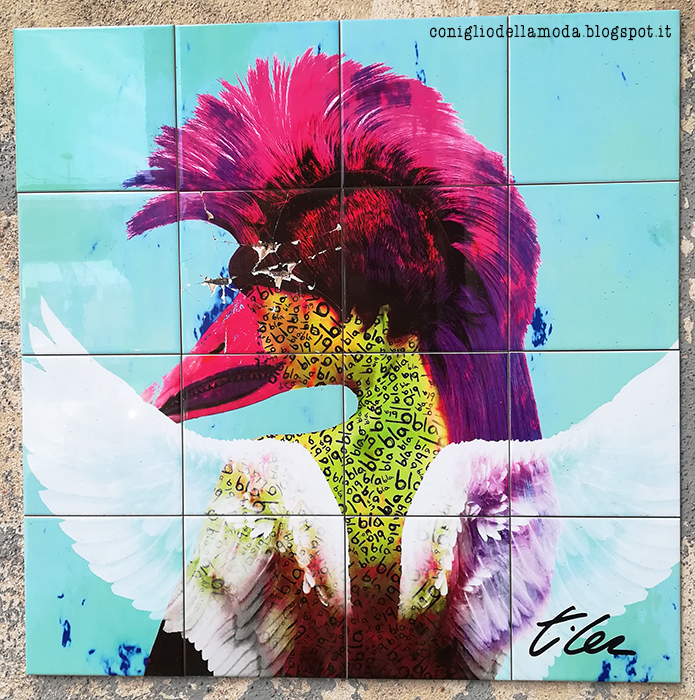
Il pomeriggio abbiamo fatto un giro in centro città. Ho osservato diversi lavori a piastrelle, quelli più tradizionali e quelli dello street artist genovese Tiler.

In the afternoon strolled in the city center. I saw different tile works, more traditional ones and those of the Genoese street artist Tiler.

Sono anche finalmente riuscita ad entrare nella cattedrale di San Lorenzo. Mi hanno colpito soprattutto l'affresco della controfacciata (XIV secolo), l'affresco di Lazzaro Tavarone con l'ultima cena nella navata destra e, soprattutto, la bomba che ha colpito la cattedrale durante la seconda guerra mondiale, senza esplodere.

I also finally managed to enter the San Lorenzo cathedral. I was particularly struck by the fresco of the counter-façade (14th century), the fresco by Lazzaro Tavarone with the last supper in the right aisle and, above all, the bomb that hit the cathedral during the Second World War, without exploding.

Durante il mio giro di shopping ho comprato una maschera viso bio al cioccolato e fango della 7th Heaven (2€ circa). Il profumo è ottimo e con una bustina ho fatto due applicazioni (ma con un dosaggio più mirato sarei riuscita a farne almeno una terza). Dopo averla usata ho sentito la pelle un po' più morbida, ma non ho notato altri benefici particolari.
Nello stesso negozio ho comprato per 5€ circa una manopola depilatoria con vari foglietti perché mi servivano i ricambi per la mia e non erano in vendita senza manopola.
In un negozietto etnico ho comprato delle lungta, le bandiere da preghiera tibetane. Poi ho visto nella vetrina di una merceria dei bottoni coloratissimi a forma di coniglietto e li ho assolutamente voluti (1€ ciascuno).
L'acquisto forse più bello, ma meno tipico è stato un paio di orecchini color ottanio con le nappine da Bershka (8€).

During my shopping trip I bought a 7th Heaven organic chocolate and mud face mask (around 2€). The perfume is great and with a bag I did two applications (but with a more calculated dosage I would have managed to do at least a third). After using it I felt my skin a little softer, but I did not notice any other special benefits.
In the same store I bought for about 5€ a depilatory mitten with various sandpaper sheets because I needed spare sheets for mine and they were not for sale without the mitten.
In an ethnic shop I bought lungta, Tibetan prayer flags. Then I saw in the window of a haberdashery colorful bunny buttons and I absolutely wanted them (€ 1 each).
Perhaps the most beautiful, but less typical, purchase was a pair of teal-colored earrings with tassels by Bershka (8€).

Come souvenir per la mia Pelosa Metà, prima di partire ho comprato il pesto della Novella e la focaccia della panetteria "Da Mario" in Salita S. Paolo 28.
I weekend con RagazzAcidella sono sempre fantastici, non vedo l'ora di ripetere!

As a souvenir for my Hairy Half, before leaving I bought pesto by Novella the focaccia of the bakery "Da Mario" in Salita S. Paolo 28.
The weekends with RagazzAcidella are always fantastic, I can not wait to have another one!

mercoledì 9 maggio 2018

Camogli - San Fruttuoso

Approfittando di un giorno di ferie ottenuto miracolosamente, sono andata un paio di giorni a Genova a trovare la mia amica RagazzAcidella.
Il primo giorno siamo andate in gita a Camogli e San Fruttuoso. Abbiamo raggiunto Camogli ida Genova n treno, arrivando per l'ora di pranzo. A tentarci, in giro per la città c'erano le enormi padelle usate per un celebre festival di cucina (che pare sia talmente affollato da essere inavvicinabile).

Taking advantage of a day of vacation I miraculously obtained, I went for a couple of days in Genoa to meet my friend RagazzAcidella.
On the first day we went on a trip to Camogli and San Fruttuoso. We reached Camogli from Genoa by train, arriving for lunch time. To tempt us, around the city there were the huge pans used for a famous cooking festival (which voices report is so crowded it is unapproachable).

Visto il bel tempo, ristoranti e focaccerie erano stipatissimi, così ci siamo fermate nel primo ristorante con un tavolino libero che ci ispirava, Il Portico Spaghetteria etc... in via Giuseppe Garibaldi 197/A, proprio sul lungomare.
Ci siamo divise un piatto di crostini misti (8€) con pesto, gorgonzola e noci, pomodori, pomodori secchi, tonno e alici, non male e più abbondanti di quel che speravo.
Poi abbiamo fatto a metà di due primi, gli spaghetti Portico con bottarga (quella vera, a fette), pepe e pomodoro (12€) e gli spaghetti Camogli con acciughe, pinoli e mollica abbrustolita (10€). I primi erano buoni, ma i secondi erano uno spettacolo.

Given the good weather, restaurants and focaccia shops were packed, so we stopped in the first restaurant with a free table that looked good, Il Portico Spaghetteria etc... in Via Giuseppe Garibaldi 197/A, right on the seafront.
We shared a plate of mixed croutons (8€) with pesto, gorgonzola and walnuts, tomatoes, dried tomatoes, tuna and anchovies, not bad and more abundant than I was hoping for.
Then we made split two first courses, Portico spaghetti with bottarga (the real one, sliced), pepper and tomato (12€) and the Camogli spaghetti with anchovies, pine nuts and toasted crumb (10€). The first ones were good, but the seconds were amazing.

Dopo mangiato abbiamo preso il battello per San Fruttuoso (14€ andata e ritorno) godendoci una mezz'oretta di sole, venticello e panorami stupendi. L'arrivo a San Fruttuoso è spettacolare con l'abbazia bianca proprio in riva al mare (e la minuscola spiaggetta stipata di gente).

After eating we took the boat to San Fruttuoso (round trip 14€) enjoying a half hour of sun, breeze and beautiful landscapes. The arrival at San Fruttuoso was breathtaking with the white abbey just by the sea (and the tiny little beach crammed with people).

Dopo avere raggiunto il paesino tramite una scalinata, abbiamo fatto un giro per il paesino, tipico, ma piccolissimo.

Climbing a staircase, we reached the village, typical, but very small.

Siamo andate a visitare l'Abbazia di San Fruttuoso (ingresso 7€), nata come chiesa nel VIII secolo grazie alla presenza di una fonte d'acqua dolce, ricostruita nel X secolo come abbazia benedettina e dal 1200 sotto l'influenza della potente famiglia Doria che nel 1953 l'ha donata al FAI che la gestisce oggi.
La struttura è piccola ma molto carina. Si sviluppa su due livelli più un solarium e la chiesa delle origini, che oggi si trova sottoterra. Nei corridoi dei livelli superiori vengono esposti resti di stoviglie dei monaci. Al pianoterra si trovano le tombe della famiglia Doria. Il chiostro è particolarmente carino, con varie colonnine e un paio di capitelli incisi. Se dal portico si guarda con attenzione alle pareti del piano superiore, si può notare almeno un'anfora inclusa dai monaci nella parete per ospitare gli uccellini.
Abbiamo visitato anche la fonte, ma non era particolarmente interessante.

We went to visit San Fruttuoso Abbey (admission 7€), born as a church in the eighth century thanks to the presence of a freshwater spring, rebuilt as a Benedictine abbey in the tenth century and from the twelfth under the influence of the powerful family Doria, who in 1953 donated it to FAI, the association that manages it today.
The structure is small but quite dainty. It's on two levels plus a solarium and the church of the origins, which today is underground. In the corridors of the upper levels, there are on display the remains of the monks crockery. On the ground floor are the tombs of the Doria family. The cloister is particularly nice, with various carved columns and a couple of  carved capitals. If you search for it looking cloister to the walls of the upper floor, you can see at least an amphora included by the monks in the wall to accommodate the birds.
We also visited the sping, but it wasn't so interesting.

Dietro al monastero si trova una passeggiata che porta ad una torre di proprietà della famiglia Doria, con lo stemma di famiglia affrescato dalle pareti, tuttora abitato.

Behind the monastery is a promenade leading to a still inhabited tower owned by the Doria family, with the family coat of arms frescoed by the wall,.

Dopo la visita abbiamo passato un po' di tempo in spiaggia, poi abbiamo ripreso il battello per Camogli. Lì abbiamo intravisto un aperitivo di pesce fritto servito da una barca, che purtroppo non abbiamo potuto provare perché eravamo in ritardo per il treno.

After the visit we spent some time on the beach, then we took the boat for Camogli. There we saw fried fish served from a boat, which unfortunately we could not try because we were late for the train.

Ci siamo consolate con una cena da Jamila, un ristorante senegalese in via dei Giustiniani 11/13 R/A.
Il cameriere era molto disponibile e ci ha spiegato tutto. Per iniziare ci ha portato un assaggio di bevanda allo zenzero e bevanda al karkadè (entrambe buonissime).
Da bere ho preso il tè senegalese che ha un sapore interessante, ma un retrogusto un po' troppo amaro. Come piatto ho scelto le polpette di pesce (soprattutto polpo), che erano ottime, abbondantissime e sugose, servite con riso bianco.

We comforted ourselves with a dinner at Jamila, a Senegalese restaurant in Via dei Giustiniani 11/13 R/A.
The waiter was very helpful and explained everything to us. To start, he brought us a taste of ginger and karkade drinks (both very good).
I choose to drink Senegalese tea which had an interesting flavor, but a bitter aftertaste. I ate the fish balls (mainly octopus) dish, which was excellent, abundant and juicy, served with white rice.

Abbiamo finito la serata con un po' di sano alcolismo al Kowalski, un pub che serve cibo e alcolici Est europei in via dei Giustiniani, 3r. Io ho provato un alcolico al miele molto buono.

We ended the evening with a bit of healthy alcoholism at Kowalski, a pub serving Eastern European food and alcoholics in via dei Giustiniani, 3r. I tried a very good honey liquor.

venerdì 24 novembre 2017

La nave degli scomparsi/The Ship of the Dead

Finalmente ad ottobre è uscito negli U.S.A. "La nave degli scomparsi" (The Ship of the Dead), l'ultimo romanzo della saga "Magnus Chase e gli Dei di Asgard" (Magnus Chase and the Gods of Asgard) dell'autore statunitense Rick Riordan. Riordan è famoso per i suoi romanzi young adult che inseriscono antiche religioni negli U.S.A. di oggi. La sua serie più famosa è quella dedicata agli dei dell'antica Grecia, "Percy Jackson e gli dei dell'Olimpo" (Percy Jackson & the Olympians), che ho recensito qui, seguita da "Gli eroi dell'Olimpo" (The Heroes of Olympus) in cui inserisce anche le  loro controparti romane, che ho recensito qui. Riordan ha scritto anche una serie dedicata agli dei egizi, "The Kane Chronicles", che ho recensito qui, più un crossover fra Olimpo ed egizi, che ho recensito qui.
Qui avevo già recensito i primi due libri di questa nuova saga dedicata agli dei nordici, "La spada del guerriero" (The Sword of Summer), del 2015 e "Il Martello di Thor" (The Hammer of Thor) del 2016.
Confermo che è la saga dell'autore che ho preferito. Trovo sempre divertentissimo l'umorismo demenziale che è il trademark dell'autore. La trama non è originalissima, non fosse per il modo geniale in cui il protagonista risolve in confronto finale. Ma quello per cui questa saga si distingue dalle altre, anche dalle precedenti di Riordan, sono i personaggi, originalissimi come ideazione (una valchiria musulmana, un nano modaiolo, un elfo sordo e addirittura un personaggio genderfluid), ma anche estremamente umani e credibili.
Mi sono ritrovata a fare il tifo per la coppia principale come un'adolescente in crisi ormonale.
Ormai all'orizzonte nell'universo delle divinità di Riordan si prospetta un mega crossover con la saga di Percy Jackson, la cosa allo stesso tempo mi intriga e mi spaventa.
Intanto mi preparo leggendo la saga destinata al dio Apollo.

Finally in October came out in the US. "The Ship of the Dead", the latest novel by the American author Rick Riordan of the saga "Magnus Chase and the Gods of Asgard". Riordan is famous for his young adult novels incorporating ancient religions in the US. of today. His most famous series is the one dedicated to the gods of ancient Greece, "Percy Jackson & the Olympians", which I reviewed here, followed by "The Heroes of Olympus", which also includes their Roman counterparts, which I reviewed here. Riordan also wrote a series dedicated to the Egyptian gods, "The Kane Chronicles," which I reviewed here, plus a crossover between the Olympus and the Egyptians, which I reviewed here.
Here I already reviewed the first two books of this new saga dedicated to the Nordic gods, "The Sword of Summer", published in 2015 and "The Hammer of Thor", published in 2016.
I confirm that it is the saga of the author I liked most. I always find funny the crazy humor that is the trademark of the author. The plot is not very original, if not for the brilliant way in which the protagonist solves the final match. But what made this saga stand out from the others, even from the earlier ones by Riordan, are the characters who are very original (a Muslim valchiria, a fashion victim dwarf, a deaf elf and even a genderfluid character), but also extremely human and credible.
I found myself shipping the main couple as a teen in full hormonal crisis.
At the horizon of the universe of Riordan's gods, I think there is a mega crossover with the Percy Jackson saga, which at the same time intrigues and frightens me.
Meanwhile, I will get ready reading the saga dedicated to the god Apollo.

giovedì 21 settembre 2017

Tokyo ESP


"Tokyo ESP" (東京ESP) è uno shōnen manga scritto e disegnato da Hajime Segawa, serializzato dalla Kadokawa Shoten  sulla rivista "Shōnen Ace" dal 2010 al 2016. La serie si è conclusa con il sedicesimo volume. Nel 2014 dal fumetto è stato tratto un anime, prodotto dalla Xebec.
 In Italia l'opera è stata pubblicata dalla dalla Panini Comics.
La protagonista è Rinka Urushiba, una liceale di famiglia poverissima che vive a Tokyo. Un giorno vede dei pesci luminosi nuotare nel cielo e, dopo averne toccato uno, sviene. Crede si tratti di un'allucinazione, ma in seguito a questo episodio scopre di aver acquisito delle capacità extrasensoriali: è diventata in grado di attraversare la materia.
Rinka non è un caso isolato: a Tokyo varie persone hanno acquisito capacità speciali. Si moltiplicano i crimini causati da ESP  e Rinka, trascinata dal suo compagno di scuola Azuma, decide di aiutare a combatterli grazie all'addestramento ricevuto da suo padre, ex poliziotto.
Ma è solo l'inizio, lentamente si rivela uno spaventoso complotto...
Tokyo ESP, al contrario di molti shōnen, è un manga completo. C'è sì un protagonista che deve diventare sempre più forte e scontrarsi con nemici sempre più potenti, ma con il supporto di una trama complessa (non il solito torneo) ed emozionante che rimane abbastanza coerente lungo tutto il fumetto (è la prima volta che i riferimenti biblici in un manga non mi fanno rizzare i capelli) e che non disdegna di parlare anche di amicizia e amore.
Verso metà del manga, Rinka lascia in modo un po' incongruo il ruolo della protagonista a Ren Jomaku, un'altra liceale, sicuramente perché i poteri della nuova arrivata sono la chiave della seconda parte del manga, ma forse perché intanto Rinka era diventata un personaggio troppo forte e maturo e il mangaka voleva mostrare una nuova storia di crescita (e abbassare l'età del personaggio principale).
Il tono è avventuroso e a tratti tragico, ma non mancano tocchi di comicità.
I personaggi tendono a riflettere lo stile esagerato degli shōnen, con cattivi malvagissimi, persone che diventano amiche dopo essersi picchiate all'ultimo sangue... ma c'è comunque un superamento di questa bidimensionalità nella maggior parte dei personaggi, a partire da Rinka che inizialmente non è affatto convinta di voler fare l'eroina. Segawa riesce a creare psicologie e relazioni complesse nonostante numero molto alto di personaggi.
Il disegno è uno dei punti forti di "Tokyo ESP", gradevole, dinamico, con anatomie credibili, curatissimo nei particolari, con divertenti riferimenti pop (il padre di Rinka sembra Wolverine, il maestro sembra Yoda e così via).
In sostanza direi che è uno dei manga migliori che ho letto negli ultimi anni. Lo consiglio assolutamente. A questo punto sono curiosa di vedere l'anime.

"Tokyo ESP" (東京 ESP) is a shōnen manga written and drawn by Hajime Segawa, serialized by Kadokawa Shoten in the magazine "Shōnen Ace" from 2010 to 2016. The series ended with the 16th volume. In 2014, it got an anime version produced by Xebec.
The protagonist is Rinka Urushiba, a very poor high school student living in Tokyo. One day she sees bright fishes swimming in the sky and after touching one of them she faints. She thinks it was an hallucination, but after this episode she discovers she has acquired extrasensory abilities: she can pass trough matter.
Rinka is not an isolated case: in Tokyo, several people have acquired special powers. In the aftermath the crimes caused by ESP multiply and Rinka, dragged by her schoolmate Azuma, decides to help fight them through the training she received by his father, a former policeman.
But it's just the beginning, slowly a scary plot gets disclosed...
Tokyo ESP, unlike many shōnen, is a complete manga. There is a protagonist who must grow stronger and fight with increasingly powerful enemies, but with the support of a complex plot (not the usual tournament) that remains coherent throughout the comic (this is the first time biblical references in a manga don't make me shiver) and that talks about friendship and love as well.
Toward the half of the manga, Rinka, a bit incongruouly, leaves the role of the protagonist to Ren Jomaku, another high school student, surely because the powers of the newcomer are the key to the second part of the manga, but perhaps also because Rinka had become too strong and mature and the mangaka wanted to show a new coming of age story (and lower the age of the main character).
The tone is adventurous and at times tragic, but there are comic touches.
The characters tend to reflect the exaggerated style of shōnen, with really really evil bad guys, people who become friends after trying to kill each other... but this two-dimensionality is overcome in most characters, starting with Rinka who at first is not so convinced about becoming an hero. Segawa creates complex psyche and relationships despite a very high number of characters.
The drawings are ione of the strong points of "Tokyo ESP", pleasing to the eye, dynamic, with credible anatomies, a lot of details, and funny pop references (Rinka's father looks like Wolverine, the teacher looks like Yoda, and so on).
To cut it short, this is one of the best manga I have read in recent years. I absolutely recommend it. At this point I'm curious to watch the anime.

lunedì 11 settembre 2017

Monastero di torba, Castelseprio, Castiglione Olona

Il primo weekend di agosto, ho organizzato una gita artistico archeologica con mio marito, mia madre e la mia amica Siobhan.
La nostra prima tappa è stato il sito UNESCO del monastero di Torba (ingresso 6€), sorto nel tardo Impero Romano con funzione difensiva e che sotto il regno longobardo assunse una funzione civile e, in seguito, religiosa, trasformandosi in convento di monache benedettine durato fino al 1482.
Con l'epoca napoleonica poi diventò un nucleo contadino, ma il FAI ha scoperto e restaurato gli affreschi longobardi trasformandolo in un museo.
Siamo stati abbastanza fortunati da fare una visita guidata.

On the first weekend of August, I organized an archeological and artistic trip with my husband, my mother and my friend Siobhan.
Our first stop was the UNESCO site of Torba Monastery (entrance 6€), built in the late Roman Empire with defensive function and that, under the Lombard kingdom assumed a civic and later a religious function, becoming a convent of Benedictine nuns that lasted until 1482.
With the Napoleonic era it was turned into a farm, but FAI discovered and restored the longobard frescoes, transforming it into a museum.
We were lucky and scored a guided tour.

Gli elementi più importanti del complesso sono la Chiesa di Santa Maria e la torre.
La chiesa che si vede oggi è stata eretta nel XI secolo recuperando, in parte, le mura del primo edificio. Nel XII-XIII secolo furono ricostruiti in stile romanico l’abside e parte dei muri perimetrali. L’interno un tempo era completamente affrescato. Oggi rimangono solo dei frammenti.
Sia la chiesa sia la torre sono state costruite con l'inserzione di materiali di spoglio provenienti da sepolcri romani.

The most important elements of the complex are the Church of Santa Maria and the tower.
The church that we see today was erected in the 11th century, recovering in part the walls of the first building. In the XII-XIII centuries the apse and part of the perimeter walls were rebuilt in Romanesque style. The interior was once frescoed, but today there are only fragments.
Both the church and the tower were built with the insertion of materials from taken from Roman tombs.

I primi tre piani della torre sono stati costruiti nel V secolo, probabilmente per ospitare l'autorità civile-militare romana. Il quarto piano, invece, è stato costruito nel VIII secolo, con l’arrivo delle monache a Torba. Nella sala al secondo piano, sono visibili tracce di decorazione risalenti alla fase precedente a quella monastica. Era usata come cripta dell’oratorio superiore e sepolcreto delle badesse, come testimoniato dai frammenti pittorici sulle nicchie in cui venivano sepolte.
Gli affreschi dell'ultimo piano sono dedicati al Cristo, ritratto ancora imperbe.
La cosa più interessante è la sequenza di otto monache senza volto sulla parete Ovest. La leggenda è che il loro volto sia stato cancellato a seguito di infrazioni del codice monastico, più probabilmente questo particolare è dovuto alla qualità della pittura usata.
Come si nota dalla qualità non elevata degli affreschi, è probabile che gli stessi siano stati eseguiti proprio dalle monache entro la fine dell’ VIII secolo, in epoca longobarda.
Nel monastero c'era un refettorio, ora gestito dal FAI, ma i prezzi non erano bassissimi e non eravamo ancora abbastanza affamati, quindi abbiamo proseguito.

The first three floors of the tower were built in the fifth century, probably to accommodate the Roman civil-military authority. The fourth floor, however, was built in the 8th century, with the arrival of the nuns in Torba. In the room at the second floor, there are visible traces of decoration dating from the phase before the monastic one. It was used as the crypt of the upper oratory and burial ground of the abbesses, as evidenced by the pictorial fragments on the niches in which they were buried.
The frescoes on the last floor are devoted to Christ, painted still as a youth without beard.
The most interesting thing is the sequence of eight faceless nuns on the west wall. The legend is that their face has been cancelled as a result of violations of the monastic code, but probably it was caused by the quality of the painting used.
Guessing by the low quality of the frescoes, it is likely that they were executed by the nuns by the end of the VIII century, in the Lombard era.
In the monastery there was a refectory, now run by the FAI, but the prices were not very low and we were not hungry enough, so we went on.

Siamo andati al Parco Archeologico di Castelseprio, anch'esso contenente monumenti UNESCO.
Qui ho finalmente visto dal vivo i bellissimi affreschi della chiesetta di Santa Maria Foris Portas (su cui ero stata interrogata durante il mio esame di Storia dell'Arte Medievale). Questo impianto decorativo ha causato incredibili problemi di datazione agli studiosi a causa della confluenza di elementi bizantini (come le scene tratte da vangeli apocrifi diffusi in Oriente) e romani. All'inizio si pensava che fossero di epoca longobarda (ma i longobardi erano nemici dei bizantini!), ma i nuovi studi stratigrafici e le datazioni al carbonio permettono un'attribuzione al X secolo, durante il periodo dell'impero degli Ottoni.

We went to the Archaeological Park of Castelseprio, which contains UNESCO monuments too.
Here I finally saw the beautiful frescoes of the church of Santa Maria Foris Portas (about which I was interrogated about during my Medieval Art History exam). This decorative system has caused incredible dating problems of to scholars because of the confluence of Byzantine elements (such as the scenes from apocryphal gospels widespreas in the East) and Roman ones. At first it was thought that they were Lombard (but the Lombards were enemies of the Byzantines!), but new stratigraphic studies and carbon dating allowed an attribution to the X century, during the period of the Ottoman Empire.

Ci siamo interrotti causa fame e siamo tornati indietro per pranzare alla Trattoria di Torba, in via Via Cesare Battisti 2 a Torba. Il locale è costituito da due sale e un giardino. L'arredamento è in stile inizio '900, molto carino.
Abbiamo preso come primi lasagne, melanzane alla parmigiana e pasta al nero di seppia con condimento di mare. Come secondo ci siamo divisi una burrata e un mix di formaggi.
Ci è piaciuto tutto molto, soprattutto i formaggi.

We stopped because we were hungry went back to Torba to have lunch at the Trattoria di Torba, in via Cesare Battisti 2. The restaurant consists of two rooms and a garden. The decor is in an early '900 style, very nice.
We took lasagna, parmigiana aubergines and squid ink pasta with seafood. We also shared a burrata and a mix of cheeses.
We liked everything, especially the cheeses.

Dopo mangiato, abbiamo finito di visitare il Parco archeologico, un "castrum" cinto da mura gote. All'interno c'erano il complesso paleocristiano di S. Giovanni (basilica e battistero), una cisterna con pozzo, la chiesa romanica di S. Paolo, case private, di varia epoca, e le dimore occupate dai canonici fino al XVI secolo. I resti delle chiese erano quelli un po' più consistenti, delle abitazioni private rimanevano solo le fondamenta.
All'interno delle mura, la visita più interessante è stato l'"Antiquarium", ospitato nel duecentesco Conventino di S. Giovanni, in cui si trova un piccolo museo in cui viene ricostruita tramite una serie reperti la storia del complesso.

After eating, we ended up visiting the Archaeological Park, a "castrum" surrounded by gothic walls. Inside there was the early Christian complex of St. John (Basilica and Baptistery), a cistern and well, the Romanesque church of St. Paul, private houses of various ages, and the dwellings occupied by canons until the sixteenth century. The remnants of the churches were the somewhat larger ones, of the private homes were left only the foundation.
Inside the walls, the most interesting visit was the "Antiquarium", housed in the thirteenth century Convent of St. John, where there is a small museum that reconstructs the history of the complex through a series of finds.

Facciamo un viaggio nel tempo e andiamo a Castiglione Olona, città natale del cardinale Branda Castiglioni che la trasformò (come Pio II fece con Pienza) seguendo l'ideale del Rinascimento.
Per prima cosa siamo andati al Castello di Monteruzzo, una villa ottocentesca ispirata ad architetture più antiche e abitata da famiglie aristocratiche milanesi. Il castello purtroppo era chiuso, ma il panorama sulla città era meraviglioso.

We travel trough time and go to Castiglione Olona, ​​the birthplace of Cardinal Branda Castiglioni who transformed it (as Pius II with Pienza) following the ideal of the Renaissance ideal city.
First we went to Monteruzzo Castle, a nineteenth-century villa inspired by more ancient architecture and inhabited by aristocratic families from Milan. The castle unfortunately was closed, but the view over the city was wonderful.

Abbiamo proseguito visitando il Palazzo Branda Castiglioni (ingresso 3€), che il famoso cardinale aveva fatto costruire per sé. Il palazzo è costituito da due parti, una del XIV e una del XV secolo.
Abbiamo avuto la fortuna di fare una visita guidata.

We continued visiting Palazzo Branda Castiglioni (entrance 3€), which the famous cardinal had built for himself. The palace consists of two parts, one of the 14th and one of the 15th century.
We were lucky enough to get a guided tour.

Dopo aver visto la bella loggetta, siamo passati al primo piano, dove si trovava una quadreria che ospitava ritratti del XVII secolo del casato Castiglioni e un grande camino. Siamo poi passati nella Camera del Cardinale, completamente affrescata nel 1423 con un giardino fiorito popolato da bambini. Al centro c'era un antico letto a baldacchino in legno pregiato del XVI secolo, le cui coperte erano ricavate da un abito talare e i cui pilastri erano affumicati, probabilmente per disinfettarlo dopo una morte per peste.

After seeing the beautiful loggia, we went to the first floor, where there was a picture gallery that housed portraits of the seventeenth century of the Castiglioni family and a large fireplace. We then went to the Cardinal's Room, completely frescoed in 1423 with a flower garden filled with children. At the center there was an antique 16th-century canopy bed made of precious wood, whose blankets were made from a priest robe and which pillars were smoked, probably to disinfect it after a plague caused death.

Il pezzo forte però era lo Studio del Cardinale con un affresco raffigurante una veduta immaginaria di Veszprem, in Ungheria, dove il cardinale era stato conte. Quest'opera d'arte è attribuita a due grandi pittori del rinascimento: Masolino da Panicale e Lorenzo di Pietro (detto il Vecchietta).
L'arredo è completato da un bellissimo mobile da sacrestia del XVII secolo in noce, da un mappamondo normale e da uno astrologico.
La nostra visita è finita al piano inferiore con la Cappella di San Martino, la cui ricca decorazione è stata attribuita al Vecchietta, che era alle dipendenze del cardinale dal 1434 circa.

The main attraction, however, was the Cardinal's Study with a fresco depicting an imaginary view of Veszprem, Hungary, where the Cardinal was count. This artwork is attributed to two great Renaissance painters: Masolino da Panicale and Lorenzo di Pietro (known as Vecchietta).
The furniture is complemented by a beautiful 17th-century sacristy furniture in walnut, a normal globe and an astrological one.
Our visit ended on the lower floor with the Chapel of San Martino, which rich decoration was attributed to Vecchietta, who worked for the cardinal since 1434.

Purtroppo era troppo tardi per visitare molto altro in città, ma siamo entrati velocemente nella Chiesa del Santissimo Corpo di Cristo (oggi nota come Chiesa di Villa), sulla piazza principale, di fronte al palazzo, attirati dalle gigantesche statue di santi in facciata. Si tratta del il primo edificio con cupola brunelleschiana al di fuori della Toscana, anch'essa commissionata dal cardinal Branda Castiglioni, costruita tra il 1437 ed il 1444 sul luogo di un oratorio del XII secolo.

Unfortunately, it was too late to visit more in the city, but we quickly entered the Chiesa del Santissimo Corpo di Cristo (now known as Villa Church) on the main square, in front of the palace, attracted by the gigantic statues of saints on the façade. It is the first building with  Brunelleschi style dome outside Tuscany, also commissioned by Cardinal Branda Castiglioni, built between 1437 and 1444 on the site of a 12th-century oratory.

Mi ha divertito soprattutto il trittico pittorico raffigurante la Vergine delle Grazie tra i Santi Rocco e Sebastiano, attribuito a Galdino da Varese (XV secolo) per via di Rocco che si cala la calzetta in maniera sexy.

I was especially amused by the pictorial triptych depicting the Virgin of Grace among Saint Roch and Saint Sebastian, attributed to Galdino da Varese (15th century) as Rocco lowers his socks in a sexy way.
Related Posts Plugin for WordPress, Blogger...