Visualizzazione post con etichetta Pechino. Mostra tutti i post

martedì 18 luglio 2017

Viaggio di nozze in cina: 28 maggio, lasciando Pechino/Honeymoon in China: 28th of May, leaving Peking

Fra la Pelosa Metà che è stata male, la brutta avventura del furto del portafogli e l'incapacità delle banche, di Pechino abbiamo visto relativamente poco. Oggi dobbiamo partire per Datong, ma abbiamo ancora la mattina libera. Non è molto, ma dobbiamo fare qualcosa di bello a tutti i costi. Andiamo allo zoo a vedere i panda.

Between the Hairy Half getting sick, the bad adventure our robbing and the problems with the banks, we saw relatively little of Beijing. Today we have to leave for Datong, but we still have a free morning. Not much, but we want to do something nice at all costs. We decide to go to the zoo to see the pandas.

Pare che lo zoo di Pechino sia il posto migliore in cui vedere i panda per i turisti che non vanno al santuario di Chengdu. E' lo zoo più grande di tutta la Cina, con il più grande numero di specie animali (circa 450) diverse ed è considerato uno dei migliori zoo del mondo. Arriviamo con la linea 4 della metropolitana, scendendo a Dongwuyuan (Beijing Zoo). Il cancello sud dello zoo è vicinissimo all'uscita B. Il biglietto combinato per lo zoo e la casa dei panda ci costa 19 CNY.
Quando entriamo la casa dei panda è ancora chiusa, quindi decidiamo di fare un giro. L'architettura è molto bella, ma le gabbie degli animali meno quotati ci paiono piccole e sporche, altro che miglior zoo del mondo, che tristezza!

It seems that the Beijing zoo is the best place to see the panda for tourists who won't go to the Chengdu sanctuary. It is the largest zoo in China, with the largest number of different animal species (about 450) and is considered one of the world's best zoos. We arrive with subway line 4, getting out at Dongwuyuan (Beijing Zoo). The south gate of the zoo is very close to exit B. The combined ticket for the zoo and the panda house costs 19 CNY.
When we enter, the panda house it is still closed, so we decide walk around. The architecture is very beautiful, but some cages seem small and dirty, so sad!

La faccia dell'intelligenza/Looking smart
Davanti ai panda però passa tutto. Quando entriamo nella casa non ne vediamo nemmeno uno, ma improvvisamente un grosso orsacchiotto peloso entra da una porticina. Isteria collettiva. Dopo essersi grattato il sedere e avere sbadigliato un po' fra le acclamazioni del pubblico, esce da un'altra porticina. Lo seguiamo nella parte esterna, molto più bella. Ci sono due panda in due giardinetti separati. Ogni giardino ha dei giochi, ma i panda sono abbastanza letargici. Uno dei due tenta almeno dieci volte di rientrare da una delle due porticine, senza capire che entrambe sono chiuse. Posso capire perché abbiano rischiato di estinguersi.

In front of the panda, however, we forget about everything. When we enter the house there isn't any, but suddenly a big bear enters from a door. Collective hysteria. After scratching it's ass and yawning between the public's cheers, it leaves from another door. We follow it on the much more beautiful outside. There are two pandas in two separate gardens. Each garden has some games, but the panda are quite lethargic. One of them tries at least ten times enter from one of two doors, without realizing that they are both closed. I can understand why they have been in danger of extinction.

Dopo esserci sciolti sui panda e avere fatto acquisti pazzi al negozio di gadget annesso, andiamo a vedere anche la tigre (che dorme), incrociando lemuri e un bellissimo laghetto pieno di pellicani. Avrei voluto vedere tanto altro, ma è tardi, dobbiamo tornare. Compriamo il pranzo e la cena in un supermercato, recuperiamo le valige in ostello e andiamo in stazione.

After staring in awe at the pandas for some time and going crazy shopping at the gadget store, we go to see the tiger (who is sleeping), stumble on the lemurs and in a beautiful pond filled with pelicans. I want to see much more, but it's late, we have to go back. We buy lunch and dinner in a supermarket, get our suitcases at the hostel and go to the station.

Usciti dalla metropolitana troviamo il delirio. La piazza della stazione è pienissima di gente e il riverbero del sole è insopportabile. Facciamo una lunghissima coda per restituire la Beijing Transportation Smart Card e riavere la caparra e i soldi caricati, ma abbiamo sbagliato fila e dobbiamo ricominciare. Per fortuna eravamo usciti in largo anticipo.
Segue una lunghissima coda per entrare in stazione (per fortuna avevamo ritirato i biglietti comprati su Travel China Guide a Badaling, quindi li avevamo già) dove ci controllano valige e documenti e anche noi passiamo dal metal detector.
Una volta dentro, il tabellone dei treni è solo in cinese, sono prossima al panico. Per fortuna la Pelosa Metà prende il controllo. C'è un cartello con scritto "waiting room" e sotto dei caratteri in cinese. Gli stessi caratteri sono sul cartellone. Confrontando il numero del treno capiamo in quale sala d'attesa dobbiamo andare. Infatti i tantissimi viaggiatori vengono smistati in sale d'attesa, da cui poi accederanno al binario giusto al giusto orario, tramite porte sorvegliate da controllori. La nostra sala d'attesa è affollatissima, con gente accampata per terra. Ci mettiamo in stile avvoltoi di fianco ad una famigliola che ha l'aria di dover prendere il treno successivo (il nostro è quello dopo) e, appena si alzano, ci lanciamo sui posti.

Leaving the subway we find a frenzy. The station square is very crowded and the sun is unbearable. We queque for a long time to return the Beijing Transportation Smart Card and get back the deposit and the money we loaded on it, but we choose the wrong queque and we have to start again. Fortunately, we had come quite earli.
There is a long queue to get into the station (fortunately we picked up the tickets we purchased on Travel China Guide at Badaling, so we already had them) where they checked our suitcases and papers and we passed into a metal detector.
Once inside, the board with the trains information is only in Chinese, I'm close to panic. Luckily the Hairy Half takes control. There is a sign saying "waiting room" and, under it, the Chinese characters. The same characters are on the board. Comparing the number of the train we understand in what waiting room we have to go. In fact, the many travelers are assigned to waiting rooms, from which they will then reach the right track at the right time, through doors monitored by inspectors. Our waiting room is crowded, with people sitted all over. We peek like vultures on a family who look like they may take the next train (ours is the later one) and, as soon as they get up, we run to get their seats.

All'interno ci sono vari negozi di souvenir e alimentari e vediamo cose improbabili come l'anatra alla pechinese da riscaldare.
Circa 20 minuti prima dell'orario scritto sul biglietto, il nostro treno compare sul cartello sopra ad una delle porte. Subito si forma una fila. Quando si aprono le porte la fila passa lentamente attraverso le obliteratrici e arriva al binario, su cui sono segnati i singoli vagoni. Si forma una nuova coda per salire in carrozza. In qualche modo riusciamo a sistemare le valige e raggiungere i posti assegnati (una ragazza gentilissima fa uno scambio per permetterci di stare vicini).
Il viaggio per Datong dura sei ore che, nonostante i panorami, il romanzo che sto leggendo e un film visto sul cellulare, non passano più. C'è un distributore di acqua calda per gli instant noodles, ma noi un un accesso di salutismo ci siamo comprati un'insalata pronta e ceniamo così.
Per fortuna che abbiamo comprato dei posti a sedere! Alcune persone si devono fare tutto il viaggio in piedi o sedute per terra e all'arrivo sono chiaramente distrutte.
Una volta a Datong non va internet. Panico. E' notte fonda e non sappiamo come raggiungere l'ostello, che pure dovrebbe essere vicino. Un gruppo di persone ci circonda e si offre di portarci all'ostello prima per 20 CNY, poi per 10. Io sono spaventatissima, e se fossero malintenzionati?
La Pelosa Metà, senza consultarmi, dice di sì e inizia a seguire un signore di mezza età, che si rivela un tassista. Comunica con me tramite una app di traduzione che usa mentre guida e ci mettiamo d'accordo anche perché ci accompagni al Tempio Sospeso il giorno dopo. Alla fine è andata bene, ma che paura!

Inside there are various souvenir and grocery stores and we see improbable things like ready made pechinese duck.
Approximately 20 minutes before the time written on the ticket, our train appears on the sign above one of the doors. Immediately a queque starts. When the doors open, the queque passes slowly through the validating machines and arrives at the track on which are written the wagons numbers. There is a new queque to get on the train. Somehow we manage arrange the bags and reach the assigned seats (a very nice girl makes an exchange to allow us to sit close).
The journey to Datong lasts six hours, and, despite the views, the novel I'm reading and a movie we watch on the phone, we get really bored and tired. There is a hot water dispenser for instant noodles, but we had a healty raptus and bought a salad for dinner.
Luckily we bought seats! Some people have to do all the trip standing or sitting on the ground and on arrival are clearly devastated.
Once in Datong, internet doesn't work. Panic. It's dark and we don't know how to get to the hostel, which should be close. A group of people surround us and offer to take us to the hostel first for 20 CNY, then for 10. I'm scared, what if they want to rob or harm us?
TheHairy Half, without taking with me, says yes and begins to follow a middle-aged man, who turns out to be a taxi driver. He communicates with me through a translation app that he uses while he drives and we agree to meet next morning to go to the Hanging Temple. It all ended well, but it was quite scary!

 
All'inizio avevamo prenotato il Datong Bravo Youth Hostel, ma, circa a un mese dalla partenza, ci avevano scritto che avevano subito danni per le piogge e non erano in grado di assicurarci la stanza per il periodo richiesto. Così abbiamo ripiegato sul Datong Rongcheng Xiangfu Express in Beiyuan Road, che aveva recensioni molto peggiori, ma costava meno ed era più vicino alla stazione.
Alla reception l'inglese è scarsissimo. La nostra stanza è piccola, puzza di fumo, ha un'unica finestra che dà sul corridoio e ha la moquette tutta impataccata. Anche le pareti sono sporche e i vicini rumorosi. Non ci interessa. La biancheria è pulita e dopo una doccia ristoratrice ci lanciamo a letto.

At first we booked Datong Bravo Youth Hostel, but about a month before leaving, they wrote us that they had suffered damage because of the rain and were unable to secure our room for the required period. So we fell back on Datong Rongcheng Xiangfu Express on Beiyuan Road, which had worse reviews but costed less and was closer to the station.
The people at the reception speak a really poor english. Our room is small, smells of smoke, has a single window on the corridor and has a dirty carpet. Even the walls are dirty and the neighbors are noisy. We don't care. The linen is clean and after a refreshing shower we go to bed.

venerdì 14 luglio 2017

Viaggio di nozze in cina: 26 e 27 maggio, Badaling e Pechino/Honeymoon in China: 26th and 27th of May, Badaling and Peking

Finalmente mio marito si è completamente ripreso, perché oggi è il giorno in cui andremo a visitare la grande muraglia! Abbiamo scelto di visitare la parte di Badaling, quella più nota, più affollata e più ricostruita, ma anche quella più comoda da raggiungere e l'unica con un museo associato.
Abbiamo scoperto la sera prima che per arrivarci non si parte più dalla stazione di Beijing North, ma da Huangtudian, che per fortuna si raggiunge comodamente in metropolitana.
Per la prima volta dobbiamo prendere un treno cinese. Secondo istruzioni arriviamo con un'ora in anticipo. Non dobbiamo fare il biglietto perché per andare a Badaling basta la carta dei mezzi di Pechino (a patto che contenga almeno 16 CNY... sia all'andata sia al ritorno. Noi pensavamo solo all'andata e al ritorno il controllore ci ha mandato di corsa a fare il biglietto).
Aspettiamo finché non si creano due file gigantesche per salire sul treno che ancora non è arrivato. All'estremità di ogni fila ci sono le macchinette automatiche per obliterare e un controllore. Il treno arriva, ma le porte non si aprono. Arrivano degli addetti che si mettono a lavare il treno mentre noi aspettiamo. E finalmente le porte aprono e noi corriamo ad accaparrarci un posto. Il treno è comodo, pulito e spazioso.

Finally my husband has completely recovered, because today is the day we are going to visit the Great Wall! We chose to visit the Badaling part, that is the most famous, the most crowded and most rebuilt, but also the most convenient to reach and the only one with an associated museum.
The night before we discovered that the train doesn't leave anymore from Beijing North, but from Huangtudian, which fortunately is easy to reach by subway.
For the first time we have to take a Chinese train. According to the instructions we arrive one hour early. We don't have to buy a ticket because to go to Badaling we can use the Beijing Transportation Smart Card (provided it has at least 16 CNY... on both ways. We thought only one way, so at the return the controller sent us running to buy a ticket).
We wait until people divide into two giant queques to get on the train, that has not yet arrived. At the end of each queque there are automatic machines to validate tickets and an inspector. The train arrives, but the doors don't open. Some men wash the train while we wait. And finally the doors open and we run to get a seat. The train is comfortable, clean and spacious.

Arriviamo a Badaling e andiamo a fare il biglietto per la Muraglia (con il passaporto, in Cina bisogna avere sempre con sé un documento per comprare qualsiasi tipo di biglietto, entrare nei posti, ecc. Fra un po' anche per andare in bagno). Nel biglietto sono inclusi anche la visita al museo della Muraglia e un misterioso "certificato eroi". Cosa sarà mai? Ci guardiamo intorno e vediamo un'insegna con la stessa scritta. Entriamo e scopriamo che con il biglietto per la muraglia abbiamo diritto a farci fare un certificato che lo attesti. I cinesi sembrano apprezzare, decidiamo di farlo anche noi. Si tratta di una cosa pacchianissima, costituita da due certificati individuali e un certificato più bello con la nostra foto di coppia sulla muraglia, fatta con un ridicolo fondale fotografico. C'è un calligrafo per scrivere i nomi sul certificato, che molla il colpo davanti al complicatissimo alfabeto occidentale e chiede di farlo da soli.
In teoria il certificato era gratuito, ma fra plastificazioni e tutto spendiamo 45 CNY. Ne è valsa la pena, ci siamo divertiti tantissimo.
E' giunta l'ora di andare al museo. E' interessante, ma non indispensabile. L'unica cosa che mi colpisce veramente è la mappa della Muraglia nelle varie epoche, non pensavo che fosse così antica, così estesa, né che sia cambiata così tanto.

We get to Badaling and we go to buy the ticket for the Wall (with the passport, in China you have to always have a document with you to buy any kind of ticket, get in places, etc., in some years probably even to go to the bathroom). The ticket includes a visit to the Museum of the Wall and a mysterious "hero certifcate". What is it? We look around and see a sign with the same mysterious phrase. We go in and find out that with the ticket for the wall we have the right to get a certificate attesting it. The Chinese seem to appreciate it, so we decide to do it too. It is a tacky thing, we get two individual certificates and a more beautiful one with a couple photo on the wall, made with a ridiculous photo backdrop. There is a calligrapher to write the names on the certificate, who gives up in front of the complicated Western alphabet and asks us to write ours.
In theory the certificate is free, but between plasticisation and all we spend 45 CNY. It was worth it, we had a lot of fun.
It's time to go to the museum. It is interesting but not essential. The only thing that really strikes me is the Map of the Wall at various times: I didn't think it was so ancient, so extensive, or that it changed so much.

Il sole picchia forte, ma c'è anche un po' di vento, il mio cappello di paglia non è l'ideale. E' la scusa perfetta per comprare... un cappello panda!!!

The sun is scorching, but there is also some wind, my straw hat is not the best choiche. It's the perfect excuse to buy... a panda hat!!!

Mangiamo al volo il nostro pranzo al sacco (ci siamo portati cibo e acqua per evitare di essere spennati in loco) e finalmente affrontiamo la Muraglia. I panorami sono spettacolari e la Muraglia pesantemente ricostruita riesce a dare comunque un senso di autenticità. E' tutto stupendo. L'entrata è in un punto abbastanza centrale. Noi andiamo a sinistra e percorriamo la sezione nord fino alla fine. Vari turisti cinesi ci fermano per fare una foto con noi buffi occidentali. Ci era già successo alla Città Proibita, ma continuo a trovarlo molto bizzarro.

We eat our lunch bag on the fly (we brought food and water to avoid being fleeced on the spot) and finally we face the Wall. The views are spectacular and the heavily rebuilt Wall can still give a sense of authenticity. It's amazing. The entrance is in a fairly central spot. We go left and walk the North section to the end. Several Chinese tourists stop us to take a picture with us strange Westerners. It already happened in the Forbidden City, but I still find it very bizarre.

Torniamo indietro con l'idea di fare anche tutta la sezione sud, ma, anche se non sono nemmeno 4 km visitabili in totale, io ad un certo punto, fra sole, vento, salite e discese abbastanza ripide, crollo. Decidiamo di tornare e per l'ultimo pezzo prendiamo un percorso parallelo meno ripido a lato della Muraglia. La sezione di Badaling oltre a questi percorsi più semplici offre anche vari bagni, una funivia, un sistema di carrucole aperte. Verso la fine della parte sud c'è anche un giardino degli orsi.
Arriviamo a Pechino alla stazione di Huangtudian e da lì prendiamo la metropolitana. All'ultimo cambio c'è un tizio di fianco a noi che si comporta stranamente. Quando scendiamo alla nostra fermata la Pelosa Metà si accorge di non avere più il portafogli con i soldi appena ritirati e tutte le carte! E io mi sono dimenticata di abilitare la mia carta per l'estero. Disastro.
Proviamo a dirlo ai controllori della stazione, ma non capiscono l'inglese, allora corriamo all'ostello e blocchiamo subito una delle due carte dal sito, ma per l'altra bisogna telefonare e non ci si riesce. Quando riusciamo, il ladro ha già speso una fortuna in un negozio di vestiti. Per fortuna con la denuncia l'assicurazione della carta dovrebbe restituirci i soldi.
E' già notte. Andiamo a fare la denuncia alla più vicina stazione di polizia, che ci facciamo indicare dal gentilissimo signore in reception. Svegliamo un primo poliziotto (che ci odia tantissimo) che non parla inglese, ma chiama un secondo con cui riusciamo a fare la denuncia. E' gentile, ma ignora sistematicamente i nostri tentativi di identificare il ladro o di dirgli in che negozio ha usato la nostra carta. Evidentemente la polizia non ha intenzione di trovarlo.
Resta il problema di come avere altri soldi per proseguire il viaggio. Dopo varie discussioni con le nostre famiglie a casa, quella della Pelosa Metà ha l'idea di spedirci soldi con Moneygram, un servizio di trasferimento denaro associato a Poste Italiane, simile al più celebre Western Union.
Il giorno dopo ci svegliamo presto e andiamo all'ICBC, una banca che dovrebbe offrire il servizio. La ragazza che smista i clienti pare non capire, poi ci dice che non c'è l'addetto. Andiamo ad un'altra sede e il ragazzo dello smistamento, con grande sicumera (anche se è evidente che non sta capendo granché) ci manda alla Bank of China. Lì ci dicono che il servizio è disponibile solo per chi ha un conto e che gli stranieri non possono aprire conti da loro. Torniamo all'ostello e chiediamo aiuto alla ragazza in reception, la quale chiama la Bank of China, che, dopo un giro di telefonate e discussioni, ci dice di andare in una certa sede e parlare con una certa persona. Andiamo... e ci dicono che no, il servizio è disponibile solo per chi ha il conto. Qui parte l'incazzatura galattica, ma non serve a niente, ci dicono di andare in posta. In posta gli addetti sono molto gentili, paiono capire la questione, sono già pronti a darci i soldi... ma poi dicono che offrono il sevizio solo con Western Union e di andare all'ICBC. Ormai siamo disperati, anche perché il giorno dopo dobbiamo partire per Datong. Andiamo all'ICBC più vicina e finalmente ci dicono che non c'è problema. In un'oretta di scartoffie abbiamo i soldi. Il resto del viaggio andrà avanti a contanti, divisi fra noi e nascosti nei posti più improbabili.

We go back with the idea of ​​walking all theSouth section as well, but even if they aren't even 4km in total, towards the middle, because of the sun, wind, the steep climbs, I get too tired to go on. We decide to return and for the last piece we take a less steep path, parallel to the Wall. The Badaling section in addition to these simplest paths also offers several bathrooms, a cable car and a pulley. Towards the end of the South section there is also a bears garden.
We arrive in Beijing at Huangtudian station and from there we take the subway. At the last change there is a guy next to us who behaves strangely. When we get down at our stop, the Hairy Half finds out he doesn't have his wallet anymore, the wallet with the money we just withdrew and all the cards! And I forgot to enable my card to withdraw money aboroad. Disaster.
We try telling the station inspectors, but they do not understand English, so we run to the hostel and block one of the two cards from the site right away, but the other one needs a phone call and we can't do it. When we succeed, the thief has already spent a fortune in a clothing store. Luckily with the police report, the insurance should return us the money.
It's already night. We go to get a police report at the nearest police station, with the help of the really nice reception guy. We wake up a first cop (who hates us) who doesn't speak English, but he calls a second one with whom we finally get the report. He's kind, but systematically ignores our attempts to identify the thief or tell him in which store he used our paper. Evidently the police doesn't want to find the thief.
It remains the problem of how to get the money to continue the journey. After several discussions with our families at home, the Hairy Half's has the idea to send us money with Moneygram, a money transfer service associated with Poste Italiane, similar to the most famous Western Union.
The next day we wake up early and go to the ICBC, a bank that should offer the service. The girl who sorts the costumers doesn't seem to understand, but after some time tells us that the employee who does that work is away. We go to another branch and the sorting boy arrogantly (although it is obvious that he is not understanding much) sends us to the Bank of China. There they tell us that the service is only available to people who have an account with them and that foreigners can't open accounts. We go back to the hostel and ask the girl at the reception for help. She calls Bank of China, that, after a round of phone calls and discussions, tells us to go to a particular branch and talk to a certain person. We go... and they tell us that no, the service is only available to people who have an account. We are enraged, but it isn't of any help, they tell us to go to the Post. At the Post, the employees are very nice, seem to understand the problem, are ready to give us the money... but then they say they only offer the service with Western Union and to go to ICBC. We are desperate, because we have to leave for Datong the next day. We go to the nearest ICBC and finally they tell us that there is no problem. After an hour of paperwork, we have the money. The rest of the trip will go on with cash, divided between us and hidden in the most unlikely places.

Torniamo all'ostello lungo Dongsi 10th Alley, che si rivela una strada piena di negozi carini. In preda all'isteria da soldi vorrei comprarmi un vestitino o qualcosa del genere, ma ho il primo impatto con i prezzi dell'abbigliamento cinese, uguali se non superiori ai nostri. Desisto.
Rimane però la voglia di festeggiare. Dopo esserci rinfrescati usciamo di nuovo e andiamo da JingZun PekingDuck Restaurant, in 4 Chunxiu Road, un ristorante consigliato dalla Lonley Planet e vari altri siti per mangiare l'anatra alla pechinese. E infatti è pieno di stranieri.

We return to the hostel along Dongsi 10th Alley, which turns out to be a street full of nice shops. In a money hysteria, I would like to buy a dress or something, but I have the first impact with Chinese clothing prices, that are the same if not higher than ours. I give up.
However, the desire to celebrate remains. After freshening up we leave the hostel and go to JingZun PekingDuck Restaurant, on 4 Chunxiu Road, a restaurant recommended by Lonley Planet and several other sites to eat Peking duck. And in fact it is full of foreigners.

Nonostante la folla riusciamo a trovare un tavolo (altro dovranno aspettare) e chiediamo un'anatra e un mapo tofu. Da bere io prendo un latte di cocco e mio marito una birra, che si accompagna all'anatra decisamente meglio. In tutto paghiamo 206 CNY, circa 27€.
Il mapo tofu è un famoso piatto cinese costituito da tofu piccante con manzo tritato e cipollotto ed è buonissimo. Forse è il piatto che piace di più alla Pelosa Metà in tutto il viaggio.
Intanto un cuoco taglia le anatre in mezzo alla sala, è uno spettacolo. Dopo qualche tempo arriva la nostra, con la pelle croccante e luccicante a coprire la carne saporitissima che si scioglie in bocca. La porzione è davvero abbondante, prendere anche il tofu è stato avventato, facciamo fatica a finire.

Despite the crowd we find a table (others have to wait) and ask for a Peking duck and a mapo tofu. I take a coconut milk and my husband a beer, which is definitely better with the duck. In total we pay 206 CNY, about 27€.
The mapu tofu is a famous Chinese dish made of spicy tofu with minced beef and spring onion and is very good. Perhaps it is the dish that the Hairy Half likes best in all our trip.
Meanwhile a chef cuts the ducks in the middle of the room as a kind of show. After some time arrives ours, with crisp and shiny skin covering a very tasty meat that melts in the mouth. The portion is really big, so to take the tofu too wasn't so smart, we struggle to finish everything.

L'anatra viene servita accompagnata da cetriolo e cipolla a bastoncini, crepe sottilissime e una salsa. Il modo corretto di mangiarla è comporre il tutto in degli involtini.
Quasi piango dalla goduria. E' il modo perfetto di concludere una brutta avventura.

The duck is served accompanied by cucumber and onion cut in sticks, thin pancakes and a sauce. The right way to eat it is to make rolls with all the ingrediens.
I almost cry for the pleasure. It's the perfect way to end a bad adventure.

martedì 11 luglio 2017

Viaggio di nozze in cina: 25 maggio, Pechino/Honeymoon in China: 25th of May, Peking

Per fortuna la Pelosa Metà oggi è abbastanza in forma. Prendiamo la linea 1 della metropolitana e scendiamo a Tianamen West.
Usciamo e siamo nella famosa Piazza Tiananmen, la più grande piazza pubblica del mondo, lunga 880 metri e larga 500, per un totale di 440.000 m².
La forma rettangolare, affiancata da sale sui due lati in qualche modo richiama quella della Città Proibita, ma gli edifici che la circondano sono di ispirazione sovietica, infatti Mao ha concepito la piazza per rendere l'enormità del Partito Comunista Cinese. Ma questa piazza è diventata tristemente famosa per i moti popolari avvenuti repressi nel sangue dall'esercito nel 1989, un episodio che il governo cerca di occultare e che quindi molti giovani cinesi non conoscono.

Luckily, the Hairy Half today feels fine. We take the underground line 1 and get off at Tianamen West.
We get off and we are in the famous Tiananmen Square, the largest public square in the world, 880 meters long and 500 wide, for a total of 440,000 m².
The rectangular shape, with buildings on the two sides, somehow recalls the Forbidden City, but the buildings are of Soviet inspiration, in fact Mao conceived the square to state the Communist Party's enormity. But this square has become sadly famous for the popular repression by the army in 1989, an episode the government is trying to conceal and that many young Chinese don't know.

Dalla piazza, passando sotto al faccione di Mao dalla Porta del Mezzogiorno, un tempo riservata all'imperatore, arriviamo alla Città Proibita, che i cinesi chiamano Palace Museum. Compriamo il biglietto (60 CNY) ed entriamo. La vista è davvero emozionante, la Città Proibita è enorme, con mura rosse e tetti gialli che luccicano al sole.
La Città Proibita si chiama così perché ne è stato vietato l'accesso ai comuni mortali per 500 anni, durante le dinastie Ming e Quing, fino al rovesciamento dell'ultimo imperatore e alla nascita della Repubblica. E' il complesso di edifici antichi meglio conservati della Cina, e il più grande complesso palaziale del mondo.
All'interno ci sono ristoranti, un bar, servizi igienici e anche ATM. Le sedie a rotelle sono gratuite (ma bisogna versare 500 CNY di deposito) e anche carrozzine/passeggini (300 CNY di deposito).

From the square, passing under Mao's face from the Meridian Gate, once reserved for the emperor, we arrive at the Forbidden City, which the Chinese call Palace Museum. We buy the ticket (60 CNY) and we enter. The view is really stunning, the Forbidden City is huge, with red walls and yellow roofs glittering in the sun.
The Forbidden City takes its name from the the fact it has been banned for the mere mortals for 500 years, during the Ming and Quing dynasties, until the overthrow of the last emperor and the birth of the Republic. It is the best preserved ancient buildings complex in China, and the largest palatial complex in the world.
Inside there are restaurants, a bar, toilets and even ATMs. Wheelchairs are free (but you have to pay 500 CNY of deposit) and also strollers (300 CNY deposit).

Gli edifici sono tantissimi, uno più bello dell'altro e sarebbe noioso e inutile elencarli tutti qui. Quello che rimane più di tutto è il senso della vastità del complesso.
Ma ci sono cose che mi rimangono in mente. C'è un bellissimo muro degli spiriti, uno degli unici tre di questo tipo rimasti in Cina, alto 5 metri e lungo 27, smaltato e decorato con un motivo a dragoni. Questo tipo di muri servivano per proteggere gli abitanti dagli spiriti maligni.
C'è anche un teatro a tre piani in legno con tanto di botole per gli ingressi drammatici.

The buildings many, one nicer than the other and it would be boring and useless to list them all here. What remains more than anything is the sense of the vastness of the complex.
But there are things that remain in my mind. There is a beautiful spirit screen, 5 meters long and 27 meters long, one of the only three of this type remaining in China, enamelled and decorated with a dragon pattern. This kind of walls served to protect the inhabitants from the evil spirits.
There is also a three-story wooden theater with lots of traps for dramatic entrances.

C'è anche un palazzo rustico inserito in un finto paesaggio rurale, fatto costruire da un imperatore che voleva provare la vita di una persona "comune". A fine della visita c'è anche il Giardino Imperiale, un classico giardino cinese disseminato di rocce e padiglioni.

There is also a rustic palace embedded in a fake rural landscape, built by an emperor who wanted to experience the life of a "common" person. At the end of the visit there is also the Imperial Garden, a classic Chinese garden with rocks and pavilions.

A metà giornata mangiamo in un ristorantino economico, al tavolo con una tripletta di cinesi che si divertono molto a guardarmi disegnare il pranzo.
I baozi di maiale non sono niente di che, ma i ravioli fritti sono favolosi.
La Pelosa Metà riesce a mangiare solo una zuppa di zucca. Beviamo un tè freddo e uno caldo. Spendiamo 80 CNY in due.

We have lunch at a cheap restaurant at the table with three Chinese who have a lot of fun watching me while I draw my lunch.
The pork buns are nothing special but the fried dumplings are fabulous.
The Hairy Half only manages to eat a pumpkin soup. We drink a cold and a hot tea. We spend 80 CNY in two.

Questo è un cuscino! Di ceramica!/This is a pillow! Made of ceramic!
La parte azzurra della corona è fatta di piume/The blue part of the crown is made of feathers
La Città Proibita non è interessante solo per la sua architettura, ma anche perché contiene tantissime mostre interessanti. Sui lati del primo cortile ci sono da una parte la Galleria di calligrafia e di pittura all'interno della Sala del Valore Marziale e dall'altra la galleria della ceramica (con pezzi che che risalgono al neolitico), alloggiata all'interno della Sala della Brillantezza Letteraria.
Vicino al muro degli spiriti ci sono una mostra di orologi (per cui si paga un biglietto extra di 10 CNY) e una si gioielli (in cui si entra con un biglietto extra di 10 CNY).
Nell'angolo nord-orientale del complesso c’è la Galleria del Tesoro, o il Palazzo completo della Pace e della Longevità, usato durante la dinastia Ming, dall'imperatrice vedova e dalle concubine imperiali. All'interno si trova un'altra serie di bei musei.
Per vedere tutto ci vorrebbe un giorno intero, anche di più, ma la nostra di più di mezza giornata ci soddisfa in pieno.

The Forbidden City is not only interesting for its architecture, but also because it contains many interesting exhibits. On the sides of the first courtyard are the Gallery of Calligraphy and Painting within the Hall of Military Eminence and on the other the Ceramic Gallery (with pieces dating back to the neolithic), housed inside the Hall of Literary Glory.
Near the Spirit Wall there is an exhibition of clocks (for which you have to pay an extra 10 CNY) and a jewelery one (where you enter with an extra ticket of 10 CNY).
In the north-eastern corner of the complex there is the Treasury Gallery, or the Palace of Tranquil Longevity, used during the Ming Dynasty, by the widow Empress and the Imperial Concubines. Inside there is another series of beautiful exhibitionss.
Seeing everything would take a whole day, even more, but our more than half a day visit satisfies us.

Usciti dalla città proibita, andiamo al vicino Parco Beihai, che anticamente era un giardino imperiale. Per entrare si paga un biglietto di 40 CNY.
E' stupendo, con un lago pieno di ninfee e circondato da salici piangenti.
Andiamo subito sull'isola al centro del lago, l'isola Qiongdao, e saliamo le scale per visitare il Dagoba Bianco, una pagoda, e il tempio lamaista ad esso collegato.
Dall'alto, in una pagoda minore, vedo eseguire degli esercizi di calligrafia. L'atmosfera è pacifica e bellissima.
Mio marito, che non si è ancora del tutto ripreso, è esausto, così rinunciamo al progetto di una passeggiata verso il lago Houhai, la Torre del Tamburo, la Torre della Campana e i vicini hutong, e torniamo all'ostello.

Exiting the Forbidden City, we go to the nearby Beihai Park, which was formerly an imperial garden. To enter, you pay a 40 CNY ticket.
It's amazing, with a lake full of water lilies and surrounded by weeping willows.
We go straight to the island at the center of the lake, Qiongdao island, and climb the stairs to visit the White Dagoba, a pagoda, and the lamaist temple connected to it.
From above, in a minor pagoda, I see a man performing calligraphy exercises. The atmosphere is peaceful and beautiful.
My husband, who has not yet fully recovered, is exhausted, so we give up the project of a walk to Houhai Lake, the Drum Tower, the Bell Tower and the nearby hutong, and we return to the hostel.

venerdì 7 luglio 2017

Viaggio di nozze in cina: 24 maggio, Pechino/Honeymoon in China: 24th of May, Peking

La Pelosa Metà sta ancora male. Dopo una colazione in ostello (lui ha preso solo un the, io un french toast costosino ma buonissimo), mi convince ad uscire da sola dicendomi che mi raggiungerà nel pomeriggio. Decido di cambiare programma e, come prima meta della giornata, scelgo una delle mete che gli interessano meno, il Tempio del Cielo. Lo raggiungo con la linea 5 della metropolitana, scandendo a Tiantan Dongmen. Fortunatamente il tempio è vicinissimo all'uscita A.
 E' costituito da una serie di edifici di epoca Ming, immersi in un parco molto grande. L'accesso al parco si paga 15 CNY, quello al tempio 20. Mi vizio anche con un'audioguida (in italiano!) che pago 40 CNY (con un deposito di 50).
Il Tempio del Cielo è il luogo dove ogni solstizio d'inverno l'imperatore si recava a pregare il cielo per avere un buon raccolto. In realtà si tratta di un altare, piuttosto che di un tempio. Come molti parchi cinesi, è circondato da un muro e ha un cancello in ogni punto cardinale.
L'architettura del tempio è fortemente simbolica: le sale del tempio sono a pianta tonda a simboleggiare il cielo, mentre la base è quadrata a simboleggiare la terra. Stessa cosa per il bordo settentrionale del parco che è semicircolare, mentre quello meridionale è quadrato.
Il primo edificio che visito è il Padiglione per l’Uccisione di animali, la sede per la macellazione di buoi, pecore, cervi e altri animali sacrificali, e il lungo corridoio ad esso collegato.

The Hairy Half still feels bad. After a breakfast in the hostel (he only drinks tea, I eat a french toast a bit pricey, but very good), he convinces me to leave by myself telling me that he will reach me in the afternoon. I decide to change the program and, as the first visit of the day, I choose the one that interests him less, the Temple of Heaven. I reach it with subway line 5, getting off Tiantan Dongmen. Luckily the temple is very close to exit A.
 It is made up of a series of Ming-era buildings, immersed in a very large park. The access to the park costs 15 CNY, to the temple 20. I also spoil myself with an audioguide (in Italian!) that I pay 40 CNY (with a deposit of 50).
The Temple of Heaven is the place where every winter solstice the emperor went to pray to heaven for a good harvest. In fact, it is an altar rather than a temple. Like many Chinese parks, it is surrounded by a wall and has a gate in every cardinal point.
The architecture is highly symbolic: the halls are round to symbolize the sky, while their bases are square to symbolize the earth. The same applies to the northern edge of the park that is semicircular, while the southern one is square.
The first building I visit is the Animal Killing Hall, the venue where the oxen, sheep, deer and other sacrificial animals where slaughtered, and the long corridor connected to it.

La parte più famosa del tempio è la Sala di Preghiera per il Buon Raccolto, montata su di una terrazza di marmo su tre livelli. I pilastri di legno (di abeti dell’Oregon) sostengono il soffitto senza chiodi o cemento Nel soffitto è intagliato un drago, simbolo dell'imperatore. Il progetto risale al 1420, ma la sala originale è stata distrutta da un fulmine nel 1889. Quella che vediamo oggi è una fedele ricostruzione risalente all'anno successivo.

The most famous part of the temple is the Hall of Prayer for Good Harvests, mounted on a marble terrace on three levels. Wooden pillars (of Oregon spruce) support the ceiling without nails or cement In the ceiling is carved a dragon, symbol of the emperor. The project dates back to 1420, but the original hall was destroyed by lightning in 1889. What we see today is a faithful reconstruction dating to the following year.

Seguendo un percorso sopraelevato (mi tolgo lo sfizio di camminare al centro, la parte riservata agli dei), si arriva agli altri edifici principali del complesso: la Volta Imperiale del Cielo che somiglia alla Sala di Preghiera per il Buon Raccolto e contiene le tavolette dedicate agli antenati dell'imperatore, il Muro dell’Eco, un muro di 65 metri costruito in modo da portare un bisbiglio da un capo all'altro, l'Altare Rotondo, costruito in base al al numero imperiale nove, con una terrazza su cui i suoni vengono amplificati.

Following an elevated route (on a whim I walked at the center, the part reserved for the gods), you get to the other main buildings of the complex: the Imperial Vault of Heaven that resembles the Hall of Prayer for Good Harvests and contains the tablets dedicated to the emperor's ancestors, the Echo Wall, a 65-meter-high wall built to bring a whisper from one end to the other, the Circular Mound Altar, built according to the imperial number nine, with a terrace on which the sounds are amplified.

Concludo la visita con il padiglione della Divina Amministrazione della Musica, dove c'è una bella mostra di strumenti musicali cinesi antichi, e con il Palazzo del Digiuno, usato dall'imperatore quando doveva astenersi da cibo, bevande e donne prima della cerimonia del solstizio d'inverno.

I conclude my visit with the Divine Music Administration, where there is a beautiful exposition of ancient Chinese musical instruments, and with the Palace of Abstinence, used by the emperor when he had to abstain from food, drink and women before the winter solstice ceremony.

Mentre visito il Palazzo del Digiuno, vengo colta da un attacco di fame: ormai l'ora di pranzo è quasi passata. Cerco il Pearl Market, una sorta di centro commerciale molto vicino al tempio, per approfittare del piano interrato, dedicato al cibo proveniente da tutta la Cina e non solo.
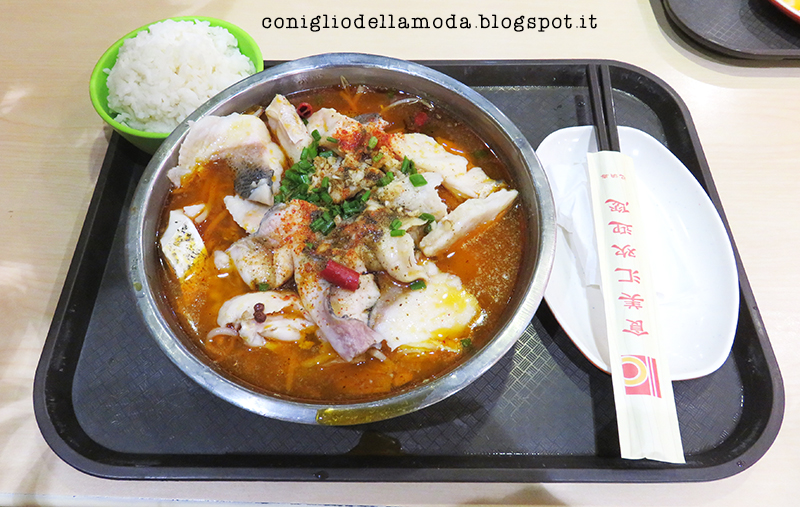
Scelgo un piatto dello Zhejiang, pesce all'olio piccante, pensando di star leggera. Mi arriva una vasca enorme di pesce, verdure e tagliatelle, il tutto affogato nell'olio piccante. E dire che avevo anche preso una ciotolina di riso per paura di non mangiare abbastanza! E' delizioso e, nonostante l'olio e la quantità, non mi rimane sullo stomaco.
Intanto nei tavoli vicini si tiene un raduno di sordomuti.
Provo a contattare la Pelosa Metà, che dice di non sentirsela di raggiungermi per le visite pomeridiane.
Prima di riprendere la metropolitana, decido di comprare il necessario per le successive colazioni e qualcosa di leggero per la Pelosa Metà in un vicino supermercato, visto che non ho capito dove si trovano quelli vicino all'ostello. Pessima idea, visto che in seguito abbiamo scoperto che c'erano vari supermercati vicinissimi e che ho dovuto portarmi la spesa sulle spalle per il resto della giornata.

As I visit the Palace of Abstinence, I suddently get really hungry: lunch time is almost passed. I look for Pearl Market, a kind of shopping mall very close to the temple, to take advantage of its food court, dedicated to food from all over China and beyond.
I chose a plate from Zhejiang, chili oil fish, thinking it is light. I get a huge tub of fish, vegetables and noodles, all drowned in chili oil. And I had also taken a bowl of rice fearing I won't eat enough! It's delicious and despite the oil and quantity, it isn't heavy.
Meanwhile, in the nearby tables, there is a gathering of deafblinds.
I try to contact the Hairy Half, who says he does not feel like joining me for the afternoon visits.
Before getting on the subway, I decide to buy something for the next breakfast and something light for the Hairy Half in a nearby supermarket, as I do not know where the ones near the hostel are. Bad idea, since later we found that there were several supermarkets close by and since I had to carry the shopping on my shoulders for the rest of the day.

La mia meta successiva è Liulichang Culture Street, una via tradizionale (hutong) considerata fra le più belle della città. La raggiungo con la linea 2 della metropolitana, scendendo a Hepingmen (uscita D) e camminando un pochino. In questa via ci sono tantissimi negozi di arti tradizionali cinesi, ma anche di cimeli del periodo maoista e di artigianato in generale.
Purtroppo quando arrivo sono già le 18 e i negozi stanno chiudendo. Arrivo in fondo alla via e mi ritrovo ad un bivio. Esploro brevemente entrambi i tratti: a sinistra si trovano negozi di alimentari e case tradizionali, a destra invece oltre alle abitazioni c'è qualche ristorante.

My next destination is Liulichang Culture Street, a traditional street (hutong) considered one of the most beautiful in the city. I reach it by subway line 2, getting off at Hepingmen (exit D) and walking a bit. In this street there are many traditional Chinese craft shops, but also shops of souvenirs of the Maoist period and of crafts in general.
Unfortunately, when I arrive, it's already 6PM and stores are closing. I arrive at the end of the road and find myself at a crossroads. I briefly explore both streets: on the left there are grocery stores and traditional houses, on the right there is some restaurant.

Sono un po' preoccupata per la Pelosa Metà, quindi decido di tornare in ostello. Mentre ero via ci hanno trasferito dalla camera deluxe del primo giorno a quella che avevamo effettivamente prenotato, più piccola, ma comunque carina. Mio marito si è un po' ripreso ed è in grado di consumare qualcosa di quello che ho comprato al supermercato. Spero proprio che il giorno dopo possa seguirmi nelle visite.

I'm a little worried about the Hairy Half, so I decide to go back to the hostel. While I was away we were transferred from the deluxe room of the first day to the room we had actually booked, smaller, but still nice. My husband got a little better and is able to eat something I bought at the supermarket. I hope that the next day he will be able to explore the city with me.

venerdì 30 giugno 2017

Viaggio di nozze in cina: 22 e 23 maggio, arrivo a Pechino/Honeymoon in China: 22th and 23th of May, arrival in Peking

Per una volta, visto che si trattava del nostro viaggio di nozze, partiamo ad un orario decente, alle 12:15, da Malpensa, con la Aeroflot, la compagnia di bandiera russa. Dopo tre ore e mezza facciamo scalo all'aeroporto Sheremet di Mosca. Voglio visitare da una vita la Russia e in particolare Mosca, quindi è un po' frustrante non poter uscire. Speravo che almeno l'aeroporto fosse interessante, ma, a parte perle come il ristorante italiano dallo slogan "benvenuto a Milano" che offre pasta, pizza e vodka, e le magliette con Putin in pose eroiche, non è granché.

For once, as it was our honeymoon, we departed at a decent time, 12:15, from Malpensa, with Aeroflot, the Russian flag company. After three and a half hours, we arrived at Sheremet Airport in Moscow. I wanted to visit Russia and especially Moscow from a lifetime, so it's a bit frustrating not to get out. I was hoping that at least the airport was interesting, but apart from pearls like the Italian restaurant with the slogan "Welcome to Milan" offering pasta, pizza and vodka (!), and the t-shirts with Putin in heroic poses, it wasn't much.

Il volo successivo, per Pechino, dura 7:15h. Per via del fuso orario di 6 ore arriviamo alle 9:50. Con qualche difficoltà ritiriamo degli yuan (CNY) all'ATM e tentiamo di fare la Beijing Transportation Smart Card al banco dell'Airport Express Train. La carta dei mezzi di Pechino funziona all'incirca come la Oyster di Londra: si caricano dei soldi con cui si possono prendere mezzi pubblici di vario tipo (metro, il treno dall'aeroporto, bus e alcuni taxi) passandola sull'apposito lettore, fino ad esaurimento fondi. In alcuni casi serve anche ad ottenere degli sconti. La carta è gratuita, ma quando la si richiede si deve versare una caparra di 20 CNY e almeno 20 CNY.
L'impiegata però non ci capisce e ci vende due biglietti dell'Airport Express Train (25 CNY a testa). Poco male, facciamo la carta alla metropolitana successiva. Per salire su qualsiasi treno, ma anche in metropolitana e per entrare in alcuni posti, in Cina c'è un controllo sicurezza con tanto di scanner per i bagagli all'ingresso. Pensavo che la mia valigia fosse in regola, ma al primo check mi ritirano il deodorante in quanto spray (mentre quello della Pelosa Metà in tutta la vacanza non è mai stato individuato. Benedetta Neutro Roberts!).
Le metropolitane sono facili da usare in quanto hanno cartelli con lucine che indicano il percorso e la stazione in cui si arriva e i nomi delle stazioni sono in pinyin (una trascrizione del cinese in caratteri latini). Arriviamo sani e salvi all'ostello, il Happy Dragon Courtyard Hostel Donsishitiao e, una volta lì, la simpaticissima ragazza della reception ci comunica che per quel giorno dormiremo in una stanza più bella di quella che avevamo prenotato, in cui saremo trasferiti il giorno dopo. Ottimo inizio!

The next flight, for Beijing, lasts 7:15h. Due to the 6 hours time zone we arrive at 9:50. With some difficulty, we withdraw some yuan (CNY) at an ATM and try to buy two Beijing Transportation Smart Cards at the Airport Express Train station. Beijing's transportation card works roughly like London's Oyster: you can charge it with money to use it on public transport of various types (metro, train from the airport, buses and some cabs) passing it on the reader, until the money ends. In some cases it can also be used to get discounts. The card is free, but when requested you have to pay a deposit of 20 CNY and charge it with at least 20 CNY.
However, the employee does not understand us and sells us two Airport Express Train tickets (25 CNY each). But we bought it at the next subway. To get on any train, but also on the subway and to get into some places, in China there is a security check with luggage scanners. I thought my suitcase was ok, but at the first check I get my deodorant confiscated as it is a spray (while the one of the Hairy Half was never detected during the whole holiday. Good Old Neutro Roberts!).
The subways are easy to use as they have lights indicating the route and the station where you are and as the station names are in pinyin (a transcript of Chinese in Latin characters). We arrive safely at our hostel, the Happy Dragon Courtyard Hostel Donsishitiao and once there, the nice reception girl tells us that we will sleep for a day in a room more beautiful than the one we booked, where we will be transferred the next day. Excellent start!

Appena sistemati usciamo e andiamo al Yonghe Gong, il Convento dei Lama.  Arrivare è semplicissimo, basta prendere la metropolitana e scendere alla stazione Yonghegong.
Per l'ingresso paghiamo 25 CNY a testa. Il biglietto è particolarmente carino perché contiene un CD. Prendiamo anche un'audioguida in inglese a 50 CNY (più caparra). 
Il Tempio dei Lama è il più celebre tempio buddista tibetano fuori dal Tibet. Fino al 1744 è stato la la residenza dell'imperatore Yong Zheng.
Il tempio è molto bello, ci sono vari fedeli che pregano, ma anche molti turisti.
L'ultima sala ospita una magnifica statua alta 18m del Buddha Maitreya (Buddha del futuro) che si ritiene essere stata scolpita in un unico blocco di legno di sandalo. In teoria non si potrebbe fotografare, ma ci sono vari cinesi che infrangono il divieto e decido di imitarli.

After we settle, we go out to Yonghe Gong, the Lama Convent. Getting there is easy, you just have to take the subway and get off at Yonghegong Station.
For entrance we pay 25 CNY each. The ticket is particularly nice because it contains a CD. We also take a 50 CNY english audioguide (plus the deposit).
The Lama Temple is the most famous Tibetan Buddhist temple outside Tibet. Until 1744 it was the residence of Emperor Yong Zheng.
The temple is very beautiful, there are many believers, but also many tourists.
The last hall houses a magnificent 18m high statue of Buddha Maitreya (Buddha of the Future) that is thought to have been carved into a single sandalwood block. In theory, one could not photograph it, but there are several Chinese who break the ban and I decide to imitate them.

I vasti cortili del tempio riflettono il calore. Ormai è ora di pranzo inoltrata e siamo stanchi. Usciamo e passeggiamo nella strada di fronte al tempio, piena di negozi di souvenir a tema buddista finché non ci imbattiamo in un localino che promette ravioli in inglese. Una volta dentro ne ordiniamo una porzione ripiena di maiale ed erba cipollina e prendiamo anche dei noodles alle melanzane. E' tutto ottimo, probabilmente fatto a mano. Paghiamo 60 CNY in due, circa 4€ a testa. In Cina il cibo oltre ad essere ottimo è anche molto economico!

The vast courtyards of the temple reflect the heat. Now it's past lunch time and we are tired. We go out and walk in the street in front of the temple, full of buddhist souvenir shops until we come across a restaurant promising dumplings in English. Once inside, we order a portion of pork and chives ones and we also take noodles with eggplants. It's all great, probably handmade. We pay 60 CNY in total, about 4€ per head. In China the food besides being great is also very cheap!

Dopo mangiato visitiamo velocemente prima della chiusura il vicino tempio dedicato a Confucio, dove si tenevano gli esami di stato. Avessi fatto io esami in un posto così bello! In particolare mi piace il padiglione al centro del laghetto. Sono stupendi anche gli alberi nodosi nei vari cortili.

After eating, we quickly visit the nearby temple dedicated to Confucius before it closes, where were held state examinations. I wish I was examined in such a beautiful place! In particular I like the pavilion at the center of a pond. There are also beautiful trees in the various courtyards.

La sera andiamo al mercato alimentare Wangfujing, un posto pensato soprattutto per turisti, dove si trovano alimenti bizzarri come scorpioni infilzati su stecchini, insetti e quant'altro. C'è anche qualche souvenir.
Ma in realtà siamo stanchi e non abbiamo fame perché abbiamo mangiato tardi, quindi decidiamo di lasciar perdere la cena e tornare all'ostello a dormire. La notte però la Pelosa Metà sta malissimo.

In the evening we go to Wangfujing food market, a place especially thought for tourists, where we find bizarre foods like scorpions on skewers, insects and more. There are also some souvenirs.
But in fact we are tired and we are not hungry because we ate late so we don't eat anything and return to the hostel to sleep. But the Hairy Half gets sick in the middle of the night.

Happy Dragon Courtyard Hostel Donsishitiao
Abbiamo prenotato l'Happy Dragon Courtyard Hostel Donsishitiao tramite Booking. Si trova in 29 Ren Min Shi Chang Xi Xiang, in un hutong (un vicolo tradizionale) vicinissimo alla stazione della metropolitana di Zhangzizhong Road (uscita D). Si trova all'interno di una casa tradizionale con un cortile interno. Le camere sono intorno al cortile, sotto una tettoia decorata da lanterne rosse che di notte è stupenda. L'edificio è molto ben tenuto.
Al centro del cortile si trova la sala comune/ristorante, che fa una cucina internazionale abbastanza buona (non ho avuto il coraggio di provare gli spaghetti però) con prezzi leggermente più alti dei ristorantini che si trovano in città, ma comunque più che accettabili. In reception c'è un frigo usato dallo staff per vendere acqua, bibite e qualche snack, estremamente utile e con prezzi onesti.
Da quello che ho capito la gestione è familiare. Tutti i membri dello staff parlano un ottimo inglese e sono estremamente gentili (ci hanno aiutato tantissimo durante un guaio che ci è capitato e che vi racconterò poi). La reception è 24 ore su 24, il check-out è entro le 12.
Per 5 notti in camera doppia con bagno abbiamo pagato 1.477,20 CNY, circa 97€, quindi circa 10€ a testa a notte, un prezzo ottimo tenuto conto della bellezza del luogo e della qualità del servizio. All'arrivo va versata una cauzione di 100 RMB che viene restituita a fine soggiorno. 

We booked the Happy Dragon Courtyard Hostel Donsishitiao via Booking. It is located in 29 Ren Min Shi Chang Xi Xiang, in a hutong (a traditional alley) near to Zhangzizhong Road Subway Station (Exit D). It is located within a traditional house with an inner courtyard. The rooms are around the courtyard, under a roof decorated with red lanterns that is really beautiful at night. The building is very well maintained.
In the middle of the courtyard is the common room/restaurant, which makes quite good international cuisine (I did not have the courage to try the spaghetti though) with slightly higher prices than the small restaurants in town but still more than acceptable. In the reception there is a fridge used by the staff to sell water, drinks and snacks, extremely useful and with honest prices.
From what I understand, the management is familiar. All staff members speak excellent English and are extremely nice (they helped us a lot during some trouble that happened to us and I'll tell you later). The reception is open 24 hours a day, check out is no later than 12am.
For 5 nights in double room with bathroom we paid 1,477.20 CNY, about 97€, so about 10€ per night each, a great price considering the beauty of the place and the quality of the service. Upon arrival, you have to pay a deposit of 100 RMB that you get back at the end of your stay.

Il primo giorno siamo stati in una camera molto spaziosa con tre letti, probabilmente una deluxe.

The first day we stayed in a very spacious room with three beds, probably a deluxe. 

In seguito ci hanno trasferito in quella che avevamo effettivamente prenotato, decisamente più piccola, ma carina, con un letto matrimoniale a occupare la maggior parte dello spazio. Le dimensioni del bagno erano equivalenti, cioè molto ridotte.
In entrambe le stanze erano forniti distributori di sapone, bagnoschiuma e shampoo, pantofole per il bagno, asciugamani grandi e piccoli, spazzolino da denti e dentifricio, ciabatte di plastica.
Non c'era il phon.
Non c'era una cabina doccia separata, per cui il bagno si bagnava ogni volta che si faceva la doccia (cosa tipica cinese, solo in un caso ho trovato una tenda da doccia), da cui la necessità di ciabatte in plastica.

They then moved us to the room we actually booked, far smaller, but nice, with a queen to occupy most of the space. The size of the bath was the same, that is, very small.
Both rooms provided soap, bubble bath and shampoo dispensers, bath slippers, large and small towels, toothbrush and toothpaste, plastic slippers.
There was no phon.
There was no separate shower cabin, so the bathroom got wet each time one showered (it is typically Chinese, I found a shower curtain only once), from which the need for plastic slippers.
Related Posts Plugin for WordPress, Blogger...