Il caffè giapponese per un italiano è acqua con un vago retrogusto, ma stamattina non resisto alla confezione autunnale e compro il caffelatte all'acero e castagna della Mt.Rainer. E' una vera scoperta, l'aroma d'acero si sente tantissimo ed è delizioso, mentre il caffè è decisamente in secondo piano, ma evita che il tutto sia troppo dolce. E' l'inizio di una dipendenza.
Japanese coffee for an Italian is water with a vague hint of falvour, but this morning I can not resist the autumn package and buy Mt.Rainer's maple and chestnut coffee. It's a great find, the maple aroma is strong and delicious, and the coffee's is only in the background, but prevents everything from being too sweet. It's the beginning of an addiction.
Su consiglio di una nostra amica che ha vissuto qualche mese a Tokyo, oggi andiamo all'
Edo-Tokyo Tatemono en (ingresso 400
¥), un museo di architettura all'aperto che si trova parecchio fuori città. Per raggiungerlo dobbiamo prendere il treno e un autobus, ma per fortuna l'autobus è ben segnalato e non ci perdiamo. In un'ora siamo al museo che si rivela una vera e propria meraviglia. E' un parco che contiene edifici giapponesi che vanno dal periodo Edo a dopo la seconda guerra mondiale, ricostruiti o addirittura smontati e trasportati al museo.
Following the advice of a friend of ours who lived some months in Tokyo, today we go to the Edo-Tokyo Tatemono en (admission 400¥), an open-air architecture museum that is quite out of town. To get there we have to take a train and a bus, but fortunately the bus is well marked and we don't get lost. In an hour we are at the museum, that is really awesome. It's a park that contains Japanese buildings ranging from the Edo period to after the Second World War, rebuilt or even dismantled and transported to the museum.
E' come fare un viaggio nel tempo visitando epoche diverse. La maggior parte degli edifici si possono visitare anche all'interno e io che adoro questo genere di cose sono al settimo cielo.
Mi colpisce particolarmente la cartoleria di fine 1800, con tutti i suoi pennelli sembra il negozio di bacchette magiche di Olivander.
Visitiamo di tutto, fattorie, granai soprelevati (nella seconda foto)...
It's like travelling back in time to visit different eras. Most of the buildings can also be visited and as I love this kind of things, I'm over the moon.
I am particularly struck by the end of 1800's stationery store that, with all its brushes seems Olivander's wands shop.
We visit all kind of things: farms, elevated barns (in the second photo)...
...bagni pubblici, case "moderne" all'occidentale e lussuosissime case tradizionali. Ci sono perfino un vecchio tram, un autobus, uno studio fotografico, la casa di un tedesco in stile misto giapponese e occidentale, il cui piano terra è stato trasformato in un bar e così via. E' tutto bello e interessante e ci divertiamo tantissimo.
... public baths, "modern" Western houses and ultra-luxurious traditional houses. There is even an old tram, a bus, a photo studio, the home Japanese and Western mixed-style of a German, whose ground floor has been converted into a bar and so on. It's everything nice and interesting and we enjoy it a lot.
In particolare io rimango affascinata nel vedere i vari tipi di vasche da bagno e gabinetti e i loro cambiamenti nel tempo. Il mio preferito è il wc di maiolica decorata con pantofole da bagno dello stesso materiale.
In particular I am fascinated by the different types of baths and toilets, and their changes over time. My favorite is the decorated tiled toilet with slippers of the same material.
Durante la visita, in una fattoria del periodo Edo ci imbattiamo in un corso di girandole. Gli anziani signori che lo tengono ci invitano a partecipare e ci regalano anche un gioco volante costruito con un cartone del latte e una cannuccia (purtroppo le girandole sono rimaste schiacciate in valigia, ma il gioco volante è sano e salvo).
In un'altra fattoria del periodo Edo, con una sezione speciale per accogliere i samurai durante la stagione della caccia, ci viene offerto del tè da una signora gentilissima che ci fa fare una visita guidata delle varie stanze.
La visita al tatemono en si classifica senz'altro come una delle esperienze più belle del viaggio.
Al momento di andarcene, faccio una pazzia e compro dei costosi calzini per tabi a coniglietti al negozio del museo.
During the visit, in a farm of the Edo period we bump into a pinwheel class. The elderly couple teaching it invite us to participate in and give us a flying toy built with a milk package and a straw (unfortunately the pinwheels got crushed in the suitcase, but the flying game is safe and sound).
In another Edo period farm, with a special section to accommodate the samurai during the hunting season, we are offered tea by a nice lady that gives us a guided tour of the various rooms.
The visit to Tatemono en certainly ranks as one of the best experiences of the trip.
When we leave, I splurged and bought some expensive bunnies tabi socks in the museum shop.

E' giunto il momento di affrontare un problema che ci perseguita dall'inizio del viaggio: abbiamo un solo biglietto per il museo dello Studio Ghibli. Avevamo provato a prenotarne due a giugno sul
sito ufficiale italiano, poco dopo avere prenotato volo e albergo. Visto che partivamo con mesi di anticipo eravamo sicuri di trovarli, ma c'era solo un posto libero in tutto il periodo della nostra permanenza. Abbiamo litigato perché ci sembrava stupido non andarci del tutto e ognuno voleva cederlo all'altro, ma alla fine, il biglietto, rigorosamente nominale e con giorno fisso, è toccato a me. Ne abbiamo trovato poi un altro per un altro giorno a prezzi da bagarino, ma la Pelosa Metà si è rifiutata di comprarlo e di farselo regalare. Una volta in Giappone abbiamo provato a comprarlo attraverso le apposite macchinette (solo in giapponese, ma in internet si trovano le istruzioni tradotte) che si trovano nei supermercati Lawson, ma ovviamente per allora era tutto esaurito.
La Pelosa Metà mi accompagna al museo a Mitaka perché speriamo almeno di riuscire a mangiare insieme al ristorante a tema, ma anche quello è all'interno del museo, inaccessibile alle persone prive di biglietto. Da fuori si vedono solo muri coperti di edera e la testa della statua del robot di Laputa che sbuca sul tetto. Così, nostro malgrado, ci separiamo dandoci appuntamento per la sera in albergo.
It's time to face a problem that haunts us from the beginning of the trip: we have only one ticket for the Studio Ghibli's museum. We tried to reserve two in June on the official Italian site (click here for tiket informations), shortly after booking the flight and hotel. Since we were months in advance we were sure to find them, but there was only one for the entire period of our stay. We fought, since it seemed stupid not to go at all and both of us wanted to give it to the other, but in the end, the strictly nominal and fixed day ticket, was given to me. Afterwards we found another for another day at scalper prices, but the Hairy Half refused to buy it and to let me buy it for me. Once in Japan we tried to buy it through the machines that can be found in Lawson supermarkets (only in Japanese, but in the Internet there are the translated instructions), but of course by then it was sold out.
The Hairy Half accompanies me to the museum in Mitaka because we hope at least to be able to eat together at the theme restaurant, but it is inside the museum, inaccessible to people without tickets. From the outside you can only see walls covered in ivy and the head of the Laputa robot statue on the roof. So, unfortunately, we have to split-up deciding to connect up at the evening at the hotel.
Quando entro nel
Ghibli Museum, il biglietto fatto su internet mi viene convertito in uno splendido biglietto in cui è inserito un frammento della pellicola originale di un film d'animazione Ghibli.
Anche se è ora di pranzo, decido di visitare il museo prima di mangiare, sperando di trovare meno gente. Ma invano! Per vedere ogni cosa c'è una coda lentissima, che rende la visita decisamente meno piacevole. Capisco perché abbiano dovuto stabilire un numero massimo giornaliero di visitatori.
Il museo è splendido, coperto d'edera, con splendide vetrate dedicate ai vari film e pieno di oggetti bizzarri con cui interagire. Sembra un po' di essere all'interno del castello errante di Howl.
Al piano terra, oltre al salone principale con le scale e gli ascensori per raggiungere gli altri piani, c'è una stanza con diorami, proiettori, pupazzetti e altro inerenti ai vari film dello studio. E' molto affascinante. C'è anche il Saturn Theater in cui vengono proiettati a rotazione corti d'animazione dello Studio Ghibli prodotti in esclusiva per il museo e impossibili da vedere altrimenti. I visitatori possono entrare al cinema una sola volta e quindi vederne uno solo. A me capita "Hoshi wo katta hi", la storia di un ragazzo che compra un seme da cui germoglia un pianeta. E' molto bello, ma il fatto che sia completamente in giapponese non è d'aiuto. In tutto il museo non ci sono spiegazioni in inglese, l'unico supporto per gli stranieri è il volantino distribuito all'ingresso con una mappa che è solo in parte in inglese e le regole di comportamento (fra l'altro non si possono fare foto all'interno).
Al secondo piano ci sono varie mostre permanenti e non permanenti. La mostra permanente su come viene realizzato un film d'animazione dello studio è la parte del museo che mi è piaciuta di più, perché è come uno studio disordinatissimo e pieno di disegni, colori e oggetti di ogni genere (chissà che fatica pulirlo!). Invece, non conoscendo bene il giapponese, non capisco la mostra con un labirinto di cartone al centro e pagine di fumetto appese alle pareti. C'è anche una stanza dedicata a Lupin III.
Al terzo piano c'è la famosa stanza con il gattobus gigante di pelouche, in cui possono entrare solo i bambini. Il povero animale sembra un po' affranto con un folto gruppo di bambini che gli saltellano addosso. Nell'angolo ci sono anche dei makkuro kurosuke.
When I enter the Ghibli Museum, the ticket I bought on the internet I is converted into a wonderful new one which it is a fragment of the original film of an animated Ghibli movie.
Although it was lunchtime, I decided to visit the museum before eating, hoping to find less people. But in vain! To see everything there is a slow queque which makes the visit far less pleasant. I understand why they had to establish a maximum number of daily visitors.
The museum is beautiful, covered with ivy, with beautiful stained glass windows dedicated to their movies and full of bizarre objects to interact with. It seems a bit the inside of Howl's Moving Castle.
On the ground floor, in addition to the main hall with the stairs and elevators to get to the other floors, there is a room with dioramas, projection, puppets and more involved in the various Studio Ghibli movies. It's very interesting. There is also Saturn Theater, where are projected Studio Ghibli animated shorts produced exclusively for the museum and impossible to see otherwise. The visitors can enter once and so they can only watch one. I end up watching "Hoshi wo katta hi," the story of a boy who buys a seed from which sprouts a planet. It's very nice, but the fact that it is completely in Japanese does not help. Throughout the museum, there are no explanations in English, the only support for foreigners is the leaflet given at the entrance with a map that is only partially in English and the behavior rules (among the other things you can't take photo inside).
On the second floor there are various permanent and non-permanent exibitions. The permanent exhibition is about how a Studio Ghibli animated film is made and it is the part of the museum that I liked the most, because it's like an untidy atelier full of drawing, colors and objects of all kinds (I think it may be hard to clean it!). Instead, not knowing Japanese very well, I do not understand the exibition with a cardboard maze in the middle and pages of comics on the walls. There is also a room dedicated to Lupin III.
On the third floor there is the famous room with a giant plush catbus, where only children can enter. The poor animal seems a bit worn out with a large group of children who jumo on him. In the corner there are also Makkuro Kurosuke.
Al terzo piano c'è anche Mamma Aiuto!, il negozio del museo, probabilmente chiamato così per via dei prezzi. C'è una fila pazzesca per vedere le cose perfino lì dentro! Alla fine compro un set di tre frammenti di pellicola de "Il castello errante di Howl" trasformati in segnalibri per la Pelosa Metà. Per me compro una cartolina-vetrata di Totoro e dei timbrini (ovviamente con l'idea di usarli per stampare dei vestiti). In tutto spendo 2073¥, uno sproposito, ma una volta nella vita si può fare.
Infine sul tetto c'è un piccolo giardino con il robot di Laputa.
A fine visita vado alla caffetteria, che si chiama Straw Hat Cafè. Ormai ho una fame da lupi. Ma nel menù del giorno trovo gli spaghetti con le polpette e preferisco evitare di pagare uno sproposito per qualcosa che probabilmente non mi piacerà. Così riprendo il carinissimo bus giallo del museo e torno in stazione, ma, prima di prendere il treno, mi fiondo in un combini e compro due onigiri che divoro come se non mangiassi da giorni. Ormai è ora di merenda.
On the third floor there is also Mamma Aiuto! ("help mom", it's in italian), the museum shop, probably so named because of the prices. There is a crazy row to see things even in there! In the end I buy a set of three pieces of film of "Howl's Moving Castle" turned into bookmarks for my Hairy Half. For me I buy a stained glass Totoro postcard and some stamps (obviously with the idea of using them to print clothes). I spend around ¥2,073, a blunder, but once in life you can do it.
Finally on the roof there is a small garden with the Laputa robot.
At the end of the visit I go to the cafe, called Straw Hat Cafe. By now I'm ravenous. But in the menu of the day I find spaghetti with meatballs and I prefer to avoid paying a blunder for something that probably I would not like (I usually don't like foreigner "italian" food). So I take the cute yellow bus of the museum to go back to the station, but before taking the train, I go to a combini and buy two onigiri that I devour as if did not eat for days. It's already mid afternoon.
Già che io e la Pelosa Metà abbiamo dovuto separarci, ne approfitto per andare in un quartiere che è lungo la strada del ritorno e mi è stato consigliato per i suoi negozi dell'usato: Koenji.
Da quello che ho letto
sul blog di Rhiannon davanti
all'uscita sud della stazione c'è Mode Off, un ottimo negozio di abbigliamento di
seconda mano, ma tutti quelli vintage sono sull'altro lato della stazione, fuori dall'uscita nord e Per arrivarci, bisogna camminare attraverso una via commerciale coperta.
Esco e non riesco assolutamente a trovare Off. Però trovo un negozietto dell'usato dove compro una gonna di jeans lunga con i bottoni davanti a 700¥. Vado dall'altra parte della stazione e trovo una via commerciale. Non faccio caso al fatto che è scoperta, ma quando incontro Floresta, un negozio famoso per le sue ciambelle a forma di animale (medito se comprarne una, ma sono troppo carine per mangiarle), che era indicato dall'altro lato, capisco di aver sbagliato qualcosa. In effetti di negozi dell'usato non ne sto vedendo.
As the Hairy Half and I already had to split up, I take this opportunity to go to a neighborhood that is on the way back and is recommended for its thrift shops: Koenji.
From what I read on Rhiannon's blog at the south exit of the station there is Mode Off, a great thrift store, but all the vintage shops are on the other side of the station, at the north exit and to get there, you have to walk through a covered shopping street.
I go out but I can't find Off. But I find a little shop where I buy an used a long denim skirt with buttons for 700¥. I go to the other exit and find a shopping street. I do give much attention to the fact it is not covered, but when I come across Floresta, a store famous for its animal shaped donuts (I think of buying one, but they are too pretty to eat), which Rhiannon said was on the other side, I understand I went the wrong way. In fact I can't see any thrift shop.
Mi dimentico di Mode Off e torno dall'altro lato della stazione. Trovo finalmente la via commerciale coperta che era un po'più a destra dell'uscita. Si rivela molto più interessante di quanto sperassi. Ci sono vari negozi dell'usato già qui. Trovo una giacca stupenda (che lascio perdere perché costa 5000¥), poi un Daiso, un negozio di una catena tutto a 100¥ famosissima, e mi lancio all'interno. Mi aspetto chissà che, ma in questa piccola sede non c'è molto. Compro comunque due ciotole di plastica di Rirakkuma.
I forget about Mode Off and go back on the other side of the station. I finally find the covered shopping street that was slightly on the right out of the station exit. It is much more interesting than I had hoped. Here there already are many thrift stores. I find a beautiful jacket (which I give up because it costs 5000¥), then a Daiso, a famous 100¥ chain store , and I throw myself inside. I was expecting a lot, but in this small venue there isn't much. Buy I still manage to buy two plastic Rirakkuma bowls.


Poi incontro 7 Sevens. Da quel che capisco è un negozio dell'usato, ma sembra che venda anche cose nuove. Ha un'aria molto più giappo-modaiola dei negozi dell'usato che ho visto finora (a parte Grand Bazaar, che però costava troppo), quindi entro e rimango affascinata. Lascio perdere a malincuore una bella gonna in finta pelle bordeaux che non saprei come lavare e opto per una maglietta stampata a forbici e degli orecchini a forma di coniglio (con metà coniglio da una parte del lobo e metà dall'altra). Arrivata in cassa vedo gli stessi orecchini a forma di dinosauro, che la commessa sta ancora sistemando e mi piacciono così tanto che decido di comprare anche quelli. In tutto spendo 2193¥. La commessa si commuove per il mio entusiasmo e decide di farmi la tessera punti anche se provo a spiegarle che sono in viaggio e dubito di tornare.
Then I come across 7 Sevens. From what I understand is a thrift store, but it seems also to sell new things. It looks much more fashionable than the Japanese thrift shops I've seen so far (apart from Grand Bazaar, that costed too much), then when I enter I remain fascinated. I grudgingly give up on a nice burgundy faux leather skirt that I don't know how to wash and buy a shissor patterned T-shirt and rabbit earrings (with the rabbit half on one side and half on the other of the lobe). I arrive to the counter where I see the same earrings in the shape of a dinosaur, that the saleswoman is still reorganizing and I like them so much that I decide to buy them too. I spend around 2,193¥. The saleswoman is moved by my enthusiasm and decides to make me discount card even if I try to explain that I'm on a tript and I doubt I will return.


Alla fine della via commerciale coperta arrivo in paradiso: stradine piene zeppe di negozi dell'usato che vendono vestiti in uno stile che mi piace molto, vintage con un tocco particolare. I prezzi in genere sono molto bassi (per il Giappone), si trovano tanti vestiti sui 1000¥ (circa 8€) e anche meno. Vedo in vendita anche alcuni capi fatto a mano, che giustamente però costano di più e quindi sono fuori dalla mia portata (peccato, alcuni come la gonna con la stampa a pane mi avevano affascinato).
Decido eroicamente di trattenermi dal comprare vestiti troppo comuni che con un po'di fortuna potrei trovare anche in Italia (peraltro in Italia, conoscendo i posti giusti, per gli abiti usati si spende meno).
At the end of the covered shopping street there is paradise: narrow streets crammed with thrift stores selling clothes in a style that I really like, vintage with a twist. The prices generally are very low (for Japan), there are many clothes for 1000¥ (about 8€) or less. I see also some handmade clothes on sale, which rightly cost more then the others and then are out of my range (too bad, as I really like some things as the bread patterned skirt).
I heroically decide to stop myself from buying too common clothes that with a little luck I might find in Italy (and in Italy, knowing the right places for used clothing, you spend less).
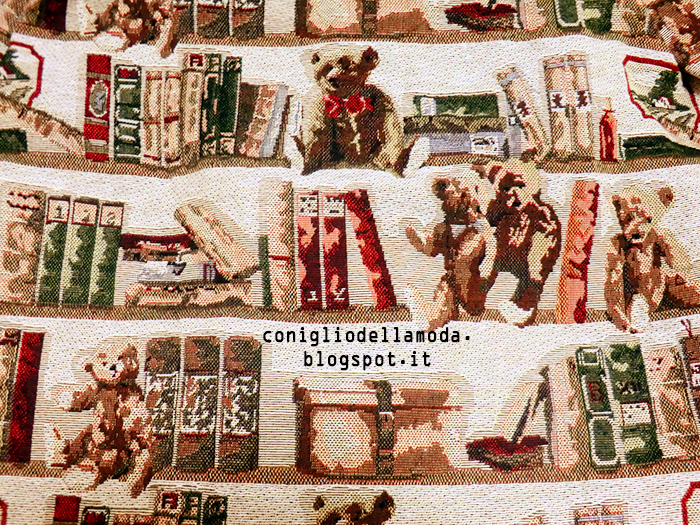
Da Steady-1 trovo la gonna dei miei sogni, di stoffa tappezzeria ad orsetti e libri (due delle mie cose preferite al mondo) con bordo in pizzo. Ovviamente fa parte delle cose fatte a mano ed è piuttosto costosa (2624¥, circa 20€). Anche se la sua fattura è semplice e sarei perfettamente in grado di farmela da sola, e nonostante l'elastico sia evidentemente stretto, decido che ne vale la pena anche solo per la stoffa e per il fatto di comprarla in Giappone. Anche questa commessa è molto felice.
In seguito vedrò la stessa stoffa usata in altri tipi di abiti (più bruttini e comunque costosi) ad Harajuku.
At Steady-1 find the skirt of my dreams, teddy bears and books (two of my favorite things in the world) upholstery fabric with lace trim. Obviously is handmade so it is rather expensive (2,624¥, about 20€). Even if its model is simple and I would be perfectly able to make it, and despite the elastic is obviously too tight, I decide that it's worth it just for the fabric and the fact of buying it in Japan. This saleswoman is very happy too.
Later I see the same fabric used in other types of clothing (more ugly and expensive, anyway) in Harajuku.
Finalmente torno in albergo dove ho appuntamento con la Pelosa Metà. La sua giornata è andata decisamente peggio: ha vagato un po'a Ueno per poi trovare il museo che gli interessava in chiusura.
I ristoranti di Asakusa che ci interessano o sono chiusi o non li troviamo. Ripieghiamo su un posto di ramen che per fare l'ordine ha un'apposita macchinetta (nonostante poi il biglietto con l'ordine venga ritirato da un cameriere!). Ci mettiamo un po'a capire come funziona. Entrambi prendiamo il ramen di maiale. Io lo scelgo super piccante e passo la serata a sputare fiamme. Prendiamo anche una porzione di gyoza, e a fine pasto stiamo esplodendo. Il tutto non è buono quanto il ramen del posto di fronte alla nostra scuola a Kyoto, ma è senz'altro migliore del ramen già abbastanza buono del centro commerciale a Odaiba.
Finally I go back to the hotel where I meet with the Hairy Half. His day was much worse: he wandered a bit in Ueno and then found the museum that interested him that was closing.
The restaurants that interest us in Asakusa are or closed or we don't find them. We fall back on a ramen place that has a special machine to make the order (although the ticket with the order is collected by a waiter!). We get some time to understand how it works. We both choose a ramen pork. I choose mine super spicy and I spend the evening spitting flames. We also take a portion of gyoza, and after dinner we are exploding. It is not as good as the ramen place in front of our school in Kyoto, but it is certainly better than the mall ramen in Odaiba.