Era qualche giorno che la Pelosa Metà voleva fare colazione al
Dunkin' Donuts vicino alla stazione della metropolitana di Tawaramachi, che è vicinissima al nostro albergo e quindi è spesso il punto di partenza delle nostre esplorazioni. Oggi è l'occasione giusta. Fare colazione seduti è un piccolo lusso. Io prendo un bastoncino alla cannella ripieno con una crema allo sciroppo d'acero niente male. Il caffè freddo con cui lo accompagno però è un errore, non sa di niente. La Pelosa Metà, più furba, prende il tè, ma la sua ciambella è meno buona. Per noi che non siamo amanti dei dolci, l'esperienza non è imperdibile.
It was from a few days that the Hairy Half wanted to have breakfast at Dunkin' Donuts near Tawaramachi metro station, which is very close to our hotel and so is often the starting point of our explorations. Today is the right day. Having breakfast while sitting is a little luxury. I take a cinnamon stick stuffed with maple syrup cream, not bad. The cold coffee with which I accompany it, however, is a mistake, it's flavourless. The Hairy Half, being smart, orders hot tea, but his donut is worst then mine. For us who are not sweets lovers, the experience is not unmissable.
Oggi andiamo ad Harajuku. Il mio portafogli sente già un fremito nella forza, ma prima di lanciarci nella via dello shopping andiamo a visitare il tempio Meiji, dedicato all'Imperatore Mutsuhito e a sua moglie, l'imperatrice Shōken. Il tempio è impregnato di nazionalismo, si sente che i giapponesi sono davvero affezionati all'imperatore che ha modernizzato il Giappone.
Appena fuori dal tempio vero e proprio c'erano le tradizionali botti di sake, ma c'erano anche occidentalissime botti di vino rosso. L'abbiamo trovata una cosa buffa, così abbiamo letto la spiegazione, secondo cui sono la la donazione di un signore giapponese che è anche cittadino onorario della Borgogna e possiede un castello (che è anche un hotel e un golf).
Today we go to Harajuku. My wallet already feels a tremor in the force, but before going to the shopping street we go to visit the Meiji temple, dedicated to Emperor Mutsuhito and his wife, Empress Shoken. The temple is imbued with nationalism, it can be felt that japanese people loves the emperor who modernized Japan.
Just outside the proper temple there were the traditional casks of sake, but there were also very western barrels of red wine. We found it strange, so we read the explanation, according to which they are the donation of a Japanese gentleman who is also an honorary citizen of the Burgundy and has a castle (which is also a hotel and a golf course).
Il tempio è gigantesco (comprende anche la maggior parte del parco), ma piuttosto sobrio. La cosa che mi ha colpito di più è stata la coppia di alberi potata come fosse uno solo, a simboleggiare l'amore della coppia imperiale.
The temple is gigantic (it includes most of the park), but rather sober. The thing that struck me the most was the couple of trees pruned like one, symbolizing the love of the imperial couple.
Dopo di che siamo andati a quella che per me è la Mecca, Takeshita Dori, la via commerciale più famosa di Harajuku. E' la culla di vari stili fra cui il lolita. In effetti vediamo qualche ragazza vestita lolita, una mori girl e altre con stili interessanti (abbiamo scelto di venire qui il sabato perché nel weekend i giovani giapponesi finalmente si liberano della divisa e si esprimono liberamente), quello che non mi aspettavo è la marea di turisti!
In effetti incontro negozi legati al mori, al lolita e allo streetstyle giapponese d'avanguardia, ma tanti altri vendono chiaramente una certa dose di pataccate per turisti.
After that, we went to what is my Mecca, Takeshita Dori, Harajuku's most famous shopping street. It was the cradle of various styles including lolita. In fact we see some girls dressed in lolita, a mori girl and others with interesting styles (we chose to come here on Saturday as in the weekend the young japanese finally get rid of school uniforms and express themselves freely), what I didn't expect is the crowd of tourists!
Indeed we come across shops related to mori, lolita and japanese avant-garde street style, but many others clearly sell a certain amount of low quality touristy stuff.
Poco dopo l'arco d'ingresso incontriamo un Daiso, a cui non resisto nonostante la delusione del giorno prima. Non me ne pento, questa sede è gigantesca e ha molta più varietà. Compro un po' di furikake (condimenti per riso) di vario tipo da portare a casa per creare un pasto giapponese veloce nei momenti di nostalgia del Giappone. Compro anche l'ennesimo washi tape. Nella sezione per turisti trovo finalmente il furin (la campanella a vento) che stavo cercando, esattamente come lo volevo e compro anche le celebri carpe a vento della festa dei bambini.
Shortly after the entrance arch we meet a Daiso, and, despite the disappointment of the previous day I can not resist. I don't regret it, this one is huge and has a lot more variety. I buy furikake (rice dressings) of various kinds to take home to create a fast Japanese meal for the moments of nostalgia. I also buy yet another washi tape. In the touristy section I finally find the furin (wind bell) I was looking for, exactly as I wanted it, and I also buy the famous children day's windsock carps.
Dall'altra parte della strada c'è Wonder Rocket. Sono sei anni che spio questa marca online, l'aspettativa è altissima. Ma purtroppo viene delusa, niente è abbastanza particolare (e soprattutto niente è abbastanza mori!). Mi provo un paio di pantaloni, ma, con sdegno della commessa, non li compro perché mi stanno da cani. Esco con le pive nel sacco. Poco dopo però incontro il negozio di Momo, la marca sorella, che è molto più grande e confortevole, ma ha più o meno gli stessi vestiti.
Tanto per comprare qualcosa decido di prendere dei costosissimi (700¥) ma carinissimi orecchini ad orsetto. Andando verso la cassa però vedo una borsa con un orso e un fungo sui 1800¥: è di
Merlot, una marca un po' mori e molto eccentrica che ho scoperto da poco, ma mi piace già tantissimo. Compro anche quella e mi sento decisamente rinfrancata rispetto alla delusione di Wonder Rocket.
Più avanti lungo la via incontro un terzo Wonder Rocket su più piani che vende diverse marche, ma non compro altro.
Across the street there is Wonder Rocket. For six years I watched this brand online, so the expectation is really high. But unfortunately I'm disappointed, nothing is special enough (and especially nothing is mori enough!). I try a pair of pants, but with disdain of the saleswoman, I don't buy because they make me feel ugly. I go out empty-handed. Shortly after, however, I come across the store of Momo, the sister brand, which is much larger and more comfortable, but more or less has the same clothes.
Just to buy something I decide to take very expensive (700¥) but very cute bear earrings. I am going to check out but I see a bag with a bear and a mushroom for 1800¥: it's by Merlot is a brand a bit mori and very eccentric that I discovered recently, but I already like a lot. I buy it too that and I feel very happy after the disappointment of Wonder Rocket.
Further along the way I meet a third Wonder Rocket of several floors that sells different brands, but I do not buy more.
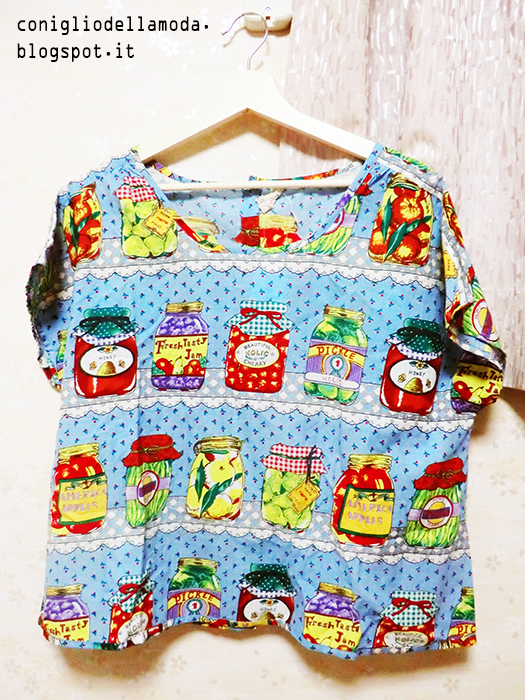
Mi aggiudico in saldo a 1080¥ questa splendida maglietta a marmellate di Freegia, con i bottoni dietro. Mi innamoro anche di un vestito a balene di BB Aroma, ma la Pelosa Metà me lo sottrae per regalarmelo a Natale.
I buy this beautiful Freegia jam shirt, with buttons behind on sale for 1,080¥. I fall in love whith a whales dress by BB Aroma, but the Hairy Half steals me it to give it to me for Christmas.
Finita Takeshita Dori proseguiamo in direzione di Omotesando. Incontriamo altri negozi affascinanti, ma non compro più niente (in seguito mi pentirò un po' di non aver folleggiato di più comprando altre cose della Merlot).
After Takeshita Dori we continue towards Omotesando. We meet other charming shops, but do not buy anything (later I'll regret a bit not having splurged more buying other Merlot things).
E' ora di pranzo ed ha iniziato a piovere. Cerchiamo sempre più disperati Gyoza Ro, un ristorante specializzato in gyoza consigliato dalla Lonley Planet. Lo individuo io grazie alla lunga coda di quelli che sembrano turisti. Per qualche strano motivo ci aspettavamo un'insegna in caratteri occidentali, per forza non lo trovavamo. Apriamo gli ombrelli e ci mettiamo pazientemente in fila. Quando finalmente entriamo, le mie gigantesche borse dello shopping ci fanno aggiudicare un posto ad un tavolo invece che al bancone centrale. Che bello riposarsi un po'! In due proviamo i quattro tipi di gyoza disponibili, al vapore, in padella e con o senza erba cipollina e aglio. Sono molto buoni.
Il pasto ci costa sui 580¥ a testa, è un po'di più di quanto segnalato dalla guida, ma è comunque piuttosto poco e ne usciamo satolli.
It's time for lunch and it starts raining. We are increasingly desperately looking for Gyoza Ro, a restaurant specialized in gyoza recommended by the Lonely Planet. I find it thanks to the long queque of what appear to tourists. For some reason we were expecting a sign in western characters, it was obvious we had problems finding it. We open our umbrellas and wait patiently in line. When finally we get there, my gigantic shopping bags make us win a place at a table instead than at the central counter. It's so nice to get some rest! In two we try the four available types of gyoza, steamed, pan-fried and with or without chives and garlic. They are very good.
The meal costs me about 580¥, is a bit more than reported by the guide, but it is still quite low and we go out pretty full.
Secondo i miei piani nel pomeriggio dovremmo andare al parco Yoyogi, dove dovrebbero esserci il festival ASEAN, con stand gastronomici di ogni paese dell'ASEAN (tailandese, vietnamita, indonesiano, ecc.), e spettacoli come danza del ventre, uno spettacolo "Miss Thailandia", musica tradizionale laotiana, canzoni popolari cambogiane, ecc. In realtà quello che mi interessa davvero è il mercato
dell’antiquariato, ma sul sito era segnalato che in caso di pioggia sarebbe saltato, così ci rinunciamo e passiamo alla prossima meta, l'Hanazono jinja a Shinjuku.
Infatti a questo tempio ogni domenica si tengono dei mercati d’antiquariato e di
bigiotteria. Quando arriviamo però non c'è nessun mercatino, forse per via della pioggia, forse per via di quelli che sembrano lavori in corso. La delusione viene un po' mitigata dall'illuminazione davvero suggestiva.
According to my plans, in the afternoon we have to go to Yoyogi Park, where there should be the ASEAN festival, with food stalls of every ASEAN country (Thai, Vietnamese, Indonesian, etc.), And shows like belly dancing, a "Miss Thailand" show, traditional Laotian music, Cambodian popular songs, etc. To tell the truth, what really interests me is the antiques market, but the site reported that in case of rain the event would be cancelled, so we give up and move on to the next destination, Hanazono jinja in Shinjuku.
In fact at this temple every Sunday is held an antique and jewelery market. When we arrive, however there is no market, perhaps because of the rain, perhaps because of what appear to be restoration works. The disappointment is a bit mitigated bythe really impressive lighting.
Decidiamo di rimandare di qualche ora la visita all'osservatorio del Tokyo Metropolitan Government Office perché piove e dubitiamo che la vista valga la pena, meglio aspettare che con il buio la città si illumini. Decidiamo di andare in una sala giochi a fare le purikura, mini foto decorate tipicamente giapponesi. Lungo la strada incontriamo un pac-man alto un paio di metri e completamente fatto di lego...
We decide to postpone the visit to the Tokyo Metropolitan Government Office observatory for a few hours because it's raining and we doubt that the view is worth, it's better to wait until after dark to see the city lights. We decide to go to an arcade to make purikura, little decorated photos that are typically Japanese. Along the way we meet a two meters high pac-man completely made of lego...
... e, praticamente sopra la nostra sala giochi, una gigantesca statua di Godzilla! Il Giappone non finisce mai di stupirci!
Nella sala giochi si può fumare, quindi c'è una discreta puzza, ma ci divertiamo comunque molto a fare le purikura e quando usciamo finalmente è buio e possiamo andare al Tokyo Metropolitan Government
Office. Dobbiamo camminare un po' fra enormi palazzoni semideserti, è quasi inquietante. In compenso i due osservatori sono gratuiti, e, visto che alternano la chiusura, ce n'è sempre uno aperto fino alle 23 (entrambi aprono alle 9:30).
Saliamo con un ascensore velocissimo e arriviamo a destinazione. L'osservatorio è pieno di bancarelle di gadget e c'è anche un ristorante.
Dicono che nelle giornate limpide guardando a ovest da qui si possa vedere il Fuji, ma ovviamente essendo notte non lo vediamo. La vista è bella, ma ho l'impressione che dal centro commerciale di Shinjuku dove eravamo stati qualche giorno prima fosse ancora più affascinante. Probabilmente perché in quel caso stavamo mangiando.
... and, practically on top of our arcade, a giant Godzilla statue! Japan never ceases to amaze us!
In the arcade smoke is allowed, so there is a bad smell, but we have fun anyway doing purikura and when we finally go out and it is dark and we can go to the Tokyo Metropolitan Government Office. We have to walk some time between huge semi-deserted skyscrapers, it is almost eerie. In return, the two observation decks are free, and, as they alternate closing, there is always one open until 23 (both open at 9:30).
We arrive at the osservatory with a fast elevator and arrive at the destination. It is filled with gadget stalls, and there is also a restaurant.
They say that on a clear day looking west from here you can see the Fuji, but obviously, being night, we don't see it. The view is beautiful, but I have the impression that the one from the commercial center in Shinjuku where we were a few days before was even more fascinating. Probably because in that case we were eating.
Per cena torniamo ad Asakusa e, dopo aver lasciato le borse in hotel, andiamo da Sometaro Okonomiyaki, un ristorante specializzato in okonomiyaki. E' un ristorante tradizionale, quindi dobbiamo toglierci le scarpe. Per fortuna le abbiamo cambiate in hotel e quindi, anche se diluvia, non abbiamo le calze troppo fradice.
La caratteristica peculiare di questo locale è che ogni tavolo ha un teppan, una piastra calda su cui gli avventori devono cuocersi il pasto. Ordiniamo due tipi di okonomiyaki di mare. Ci vengono serviti elegantemente disposti in due ciotole. Il cameriere ci spiega come mescolare gli ingredienti, versarli sulla piastra e cuocerli. E' un'esperienza divertente e per fortuna il risultato è buono.
Anche le granite tradizionali sembrano invitanti, ma sono quasi sazia e ho paura che siano troppo grosse, quindi lascio perdere. Pago 800¥, veramente poco.
We go back to Asakusa for dinner and, after leaving the bags at the hotel, we go to Sometaro Okonomiyaki, a restaurant specialized in okonomiyaki. It's a traditional restaurant, so we have to take our shoes off. Fortunately we changed tham at the hotel and so even if it pours, our socks aren't too soggy.
The distinctive feature of this place is that every table has a teppan, a hot plate on which the customers have to cook their meal. We order two types of seafood okonomiyaki. The ingredients are served elegantly arranged in two bowls. The waiter explains us how to mix the ingredients, pour them on the plate and cook them. It's fun and fortunately the result is good.
Even the traditional shaved ices seem tempting, but I'm already pretty satisfied and I fear they are too big, so I give up. I pay 800¥, very little.