mercoledì 7 ottobre 2015

Japan 9/9/15: Harajuku, Omotesando

Oggi volevamo andare all'acquario, ma quando abbiamo scoperto che in quello di Tokyo non c'erano squali balena, abbiamo lasciato perdere e abbiamo deciso recuperare delle cose che avevamo saltato.
Per prima cosa andiamo a Shinjuku dove c'è il Bunka Gakuen Costume Museum, un museo del costume che mi interessa tantissimo. Arrivati, lo troviamo chiuso, e dire che avevo controllato apposta il sito la sera prima e non c'era scritto niente! Da un cartello in giapponese capiamo che rimarrà chiuso fino al 24. Ci rimango malissimo, ma cerco di non abbattermi.
Prendiamo la metropolitana e torniamo ad Harajuku.
Harajuku è il quartiere delle crepes, se ne vendono ovunque e sono super decorate. Guardando le riproduzioni in plastica delle vetrine di alcuni posti take away mi chiedo come si possano mangiare mentre si cammina. La risposta che trovo osservando i passanti è: avvolte da un triangolo di cartone, con tecnica mista di morsi e cucchiaino.

Today we wanted to go to the aquarium, but when we found out that in Tokyo's one there weren't whale sharks, we gave up and decided to visit some things we had missed.
First we go to Shinjuku where there is the Bunka Gakuen Costume Museum, a costume museum that interests me a lot. We arrive and we find it closed, even if I specifically checked the site the night before and it didn't advise about it! By a sign in Japanese we understand that it will remain closed until the 24th. I'm really disappointed, but I try not to feel let down.
We take the subway and go back to Harajuku.
Harajuku is the neighborhood of crepes, they are sold everywhere and are super decorated. Looking at the plastic reproductions of the windows of take away some places I wonder how one can eat them while walking. The answer I find watching passersby is: wrapped in a cardboard triangle, with a mixed tecnique of bites and teaspoon.

Passando attraverso Takeshita Dori non resisto ad entrare da Paris Kid's, un negozio di accessori e bigiotteria con prezzi medi. In questa sede i turisti non pagano l'iva, che fortuna! Compro un elastico per capelli di pelouche con fiocco, un paio di orecchini a tema Alice nel Paese delle Meraviglie, una spilla con stelle molto simile a quelle che andavano qualche anno fa e un geniale anello a forma di forbici. All'interno scopro che ci sono ancora delle fukubukuro, borse a sorpresa con dentro merce scontantissima tipiche dei saldi giapponesi. Non pensavo che ne avrei viste ancora a settembre e non resisto a provare questa esperienza. Scelgo la fukubukuro a forma di pesce rosso che è carinissima e costa piuttosto poco. Come prevedibile è un po'una fregatura: di tutta la paccottiglia che c'è dentro mi piacciono solo due fermacapelli e un braccialetto di legno. Decido di tenere anche la coppia di ciglia finte: non le ho mai usate, ma magari è l'occasione giusta per provare. Il resto lo regalerò. Alla fine non è andata così male. In totale ho speso 1732¥.

Going through Takeshita Dori I can't resist shopping at Paris Kid's, an accessory and jewelery shop with average prices. Here tourists do not pay VAT, lucky! I buy a plush scrunchie with a bow, a pair of Alice in Wonderland earrings, a pin with sparklystars, very similar to those that were so trendy a few years ago and a smart scissors-shaped ring. Inside I find that there are still fukubukuro, surprise bags with super discounted goods, typical of japanese sales. I did not think I would have found them in September and can not resist to try this experience. I choose the goldfish shaped fukubukuro that is rather cute and costs little. Predictable is slightly disappointing: of all the stuff that's inside I like only two hair clips and a wooden bracelet. I decide to keep the pair of false eyelashes too: I never used them, but maybe it's a good time to try. I'll give the rest away. In the ehe end is not so bad. I spent 1,732¥ in total.

Ripassiamo da Daiso perché la Pelosa Metà vuole assolutamente comprare la salsa al sesamo dello shabu shabu di ieri sera. Io compro solo un pacchetto di alghe nori per fare del sushi casalingo.

We go to Daiso again because the Hairy Half absolutely wants to buy the shabu shabu sesame sauce of last night. I buy only a package of nori seaweed to make sushi at home.

Vorrei fare qualche altro giro per negozi perché in quasi tutti c'è ancora qualcosa in saldo e mi piacerebbe cercare qualcosa di Merlot, ma piove sempre più forte e la Pelosa Metà si sta spazientendo. Devo lasciar perdere, ma intanto riesco a vedere dal vivo Nile Perch (costa tantissimooo!), che adoravo nel mio periodo più fairy kei.

I would like to do some more shopping because in almost every shop there is still something on sale and I'd like to buy something by Merlot, but it rains harder and harder and the Hairy Half is impatient. I have to let it go, but in the meantime I can see in person Nile Perch (it was really expensive!), a shop I loved in my most fairy kei period.

Arriviamo al tempio Togo, dedicato all'omonimo ammiraglio che sconfisse la flotta russa durante la guerra russo-giapponese (1904-5). In realtà non c'è molto da vedere, quindi proseguiamo velocemente verso la prossima meta, l'Ota Memorial Museum. Già ho i piedi zuppi, poi lungo la strada riesco anche a scivolare e cadere in una pozzanghera. Il mio umore precipita sottoterra.

We arrive at Togo temple, dedicated to the eponymous admiral who defeated the Russian fleet during the Russian-Japanese War (1904-5). There is not much to see, so we continue quickly towards the next destination, the Ota Memorial Museum. My feet are already soaked, then I also slip and fall in a puddle. My mood deteriorated.

http://www.artgallery.nsw.gov.au/collection/works/258.2012.55/
L'Ota Memorial Museum (ingresso 700¥) per fortuna me lo risolleva: è un bellissimo museo dedicato agli ukiyo-e, che non solo contiene opere famose di Hiroshige, Hokusai, Utamaro e molti altri, ma ha anche tutte le spiegazioni in giapponese e in inglese, cosa per niente scontata nei musei nipponici.
Nonostante la presenza di tante opere di maestri di primo livello, i miei ukiyo-e preferiti sono di artisti che non conoscevo e che sono contenta di aver scoperto: Utagawa Sadahide, Tsukioka Yoshitoshi e il contemporaneo Yamaguchi Akira con le sue stampe tradizionali raffiguranti la Tokyo moderna.
Ormai è chiaro che abbiamo previsto di spendere molto più di quanto stiamo effettivamente spendendo, per cui non mi faccio più troppi problemi a fare acquisti folli. Nel negozio del museo, per 1700¥ compro un volume rilegato come un manga moderno che raccoglie i manga naturalistici di Hokusai.

The Ota Memorial Museum (admission ¥ 700) luckily uplifts me: it's a beautiful museum devoted to ukiyo-e, which not only contains famous works by Hiroshige, Hokusai, Utamaro and many others, but also has all the explanations are in Japanese and English, which isn't obvious at all in Japanese museums.
Despite the presence of so many works by masters, my favorites are by ukiyo-e artists I did not know and I'm happy to have discovered them: Utagawa Sadahide, Tsukioka Yoshitoshi and our contemporary Akira Yamaguchi with its traditional prints depicting modern Tokyo.
It is now clear that we planned to spend much more money than we are actually spending, so I do not fuss too much about making crazy purchases. In the museum shop, I buy a 1700¥ volume, bound as a modern manga, that collects nature manga by Hokusai.

Quando usciamo fortunatamente siamo un po' più asciutti. Ci dirigiamo sotto la pioggia scrosciante in direzione di Omotesando. Incrociamo Kiddyland ed insisto per entrare nonostante siamo già stati nella sede di Odaiba. La Pelosa Metà inizialmente è restia, ma poi si innamora del piano dedicato ai Peanuts, dove gli regalo una maglietta. Per me invece prendo un gachapon dei Sumikko Gurashi: mi capita un astuccio carinissimo, evviva!

When we go out, fortunately we are a bit drier. We head in the pouring rain in the direction of Omotesando. We came across Kiddyland and I insist to enter even though we already visited one in Odaiba. The initially reluctant Hairy Half, falls in love with the floor dedicated to Peanuts, where I buy him a t-shirt. For me, I take a Sumikko Gurashi Gachapon: I get a cute pencil case, hurray!

Insisto per andare a vedere la famosa Cat Street, una via considerata fra le più belle di Tokyo per via delle sue casette basse e dei suoi negozi. Sarà per via del diluvio, ma non la trovo niente di davvero speciale. In compenso in uno dei famosi negozietti per 600¥ compro dei takoyaki con uova di merluzzo piccanti e maionese. Sono spettacolari, e mangiati bollenti sotto il tendone del negozio che mi protegge dalla pioggia sono ancora più buoni.

I insist on going to see the famous Cat Street, a street considered among the finest of Tokyo because of its low houses and shops. It may be because of the flood, but I can not find anything really special in it. On the other hand in one of the famous shops I buy for 600¥ spicy cod roe and mayonnaise takoyaki. They are awesome, and eaten warm under the store awning that protects me from the rain are even better.

La nostra prossima tappa è di nuovo gastronomica: si tratta di Kukuruza Popcorn, un negozio che vende popcorn gourmet dai gusti strani. Io compro quelli al nuovo gusto con olio di cocco e sale marino, la Pelosa Metà li prende al formaggio e curry. Sono buonissimi e davvero particolari. Non resisto e torno dentro a comprare quelli a tartufo e formaggio. Le confezioni piccole costano sugli 850¥.

Our next stop gastronomic again: it is Kukuruza Popcorn, a shop selling gourmet popcorn with strange tastes. I buy the new taste with coconut oil and sea salt, the Hairy Half buys the cheese and curry ones. They are very good and really special. I can not resist and go back inside to buy the truffles and cheese ones. The small packages cost about 850¥.

La Pelosa metà non ce la fa più a camminare sotto la pioggia scrosciante e perfino io devo ammettere che in queste condizioni è difficile godersi le visite. Torniamo in hotel passando a comprare la cena in un combini. Togliersi i vestiti fradici è un sollievo.
Accedo al wi-fi e dal commento di un mio follower giapponese di Instagram scopro che è in corso un tifone. Ecco perché piove così tanto! Peraltro non è un tifone da poco, si tratta del tifone Etau che ha causato inondazioni, frane e qualche morto nel Giappone orientale. Pare che a Nikko, dove eravamo stati il giorno prima, sia crollata una strada. Accidenti! Per fortuna pare che domani finirà.
Il mio fidanzato per cena ha preso una porzione enorme di oden, ingredienti vari cotti in un brodo dolciastro, in modo da farla assaggiare anche a me. E' tutto buono, alcuni ingredienti di più e altri di meno, ma la cosa migliore dopo una giornata sotto il diluvio è il brodo, caldo e confortante. Io per cena ho scelto un inari soba liofilizzato. Quando lo scarto per aggiungere l'acqua calda mi aspetta una sorpresa: ci sono dei naruto a forma di fiorellino, che carini! Mangiamo anche un dolcetto con custard alla banana, discreto, e una buona birra che abbiamo comprato a Nikko.

The Hairy Half is tired to walk in the pouring rain and even I have to admit that in these conditions it is difficult to enjoy the visits. We go back to the hotel stopping to buy dinner in a combini. To strip off the wet clothes is a relief.
I access wi-fi and from the comment of one of my Japanese Instagram followers I find that there is an ongoing typhoon. That's why it rains so much! It is not even a little typhoon, it is the Etau typhoon that caused floods, landslides and some death in eastern Japan. It seems that in Nikko, where we had been the day before, is a road collapsed. Damn! Fortunately it seems that tomorrow it will end.
My boyfriend for dinner took a huge portion of oden, various ingredients cooked in a sweet broth, so that I can try it too. It's all good, some ingredients more and others less, but the best thing after a day in the flood is the broth, warm and comforting. I for dinner I chose a lyophilized Inari soba. When I open the package to add the hot watera surprise waits for me: there are flower shaped naruto, so cute! We also eat a sweet with banana custard, discreet, and a good beer that we bought in Nikko.

Japan travel journal 9/9/15: Harajuku, Omotesando


martedì 6 ottobre 2015

Japan 8/9/15: Tsukiji, Ginza, Marunouchi

La prima meta del mattino è il famoso mercato del pesce Tsukiji in cui, verso le 5 di mattina c'è la famosa asta dei tonni. Noi ci rifiutiamo di alzarci così presto e di prendere un costosissimo taxi per arrivare, visto che a quell'ora i mezzi ancora non vanno, ma decidiamo di visitarlo comunque.
Lungo la strada ci imbattiamo nel ristorante di sushi in cui vogliamo fare colazione, Sushi Zanmai, e, vista la nostra tendenza a perderci, decidiamo di fermarci subito. Il sushiman è molto simpatico e tenta di parlarmi in giapponese. Io sorrido e annuisco fingendo di capire. La Pelosa Metà sceglie il set dedicato al tonno, con tonno magro, medio e grasso, tre maki al tonno, tonno scottato e un gunkan negitoro (tartare di tonno e cipolla). Io scelgo il misto con tonno, caviale di salmone, frittata, seppia, anguilla di mare, strano caviale di aringa croccante, sgombro, uova di riccio, spigola, capasanta.
E' il sushi più buono che abbia mangiato. I sapori e le consistenze sono perfette. Un'esperienza mistica. Peraltro a un prezzo davvero ottimo, visto che pago 2000¥.
Dopo colazione, ci imbattiamo nel Namiyoke jinja, la cui divinità protegge i navigatori, e finalmente troviamo il mercato. Si capisce subito che non è un posto pensato per i turisti, ma un luogo dove si lavora. E' buio, umido e percorso da carrelli trasportatori che non guardano in faccia a nessuno. Restiamo solo il tempo di un giro veloce.

The first destination of the morning is the famous Tsukiji fish market where, at about 5 in the morning there is the famous tuna auction. We refuse to get up so early and to take an expensive taxi, because at that time the public transport still don't work, but we decide to visit it anyway.
Along the way we come across the sushi restaurant where we want to have breakfast, Sushi Zanmai, and, given our inclination to get lost lost, we decide to stop immediately. The sushiman is very nice and try to talk to me in Japanese. I smile and nod, pretending to understand. The Hairy Half chooses the tuna set, with low-fat, medium fat, and fat tuna, three tuna maki, seared tuna and a gunkan negitoro (tuna and onion tartare). I choose the mixed set with tuna, salmon roe, omelette, squid, sea eel, strange crunchy herring caviar, mackerel, sea urchin eggs, sea bass, scallop.
It's the most delicious sushi I have ever eaten. The flavors and textures are perfect. A mystical experience. Moreover at a really great price, since I pay 2,000¥.
After breakfast, we run into Namiyoke jinja, whose divinity protects sailors, and finally we find the market. It soon becomes clear that it isn't a place designed for tourists, but a place for work. It's dark, damp, and full transporters who do not look at anybody. We remain only the time to visit it quickly.

La seconda meta è il Sony Building, ma, andando in quella direzione ci imbattiamo nel Kabuki-za, il teatro del Kabuki. Visto che ha incominciato a piovere forte, decidiamo di fermarci e siamo fortunatissimi perché ci aggiudichiamo scontatissimi a 1500¥ gli ultimi posti in piedi per l'atto che sta per cominciare (normalmente uno spettacolo kabuki dura 4:30h, ma si può comprare anche il biglietto per un solo atto, che si chiama makumi), e non dobbiamo nemmeno aspettare per entrare. Nella lobby del livello 4 affittiamo 500¥ (più 1000 di deposito) quella che viene chiamata audioguida, ma in realtà è uno schermo su cui passano i sottotitoli in inglese dello spettacolo (a posteriori ne sarebbe bastata una in due).
La rappresentazione a cui assistiamo è Futatsu Chôchô Kuruwa Nikki. Abbiamo paura possa essere un po' noiosa, invece si rivela divertentissima e incredibilmente pacchiana. Basta dire che in una scena c'era un samurai decaduto diventato venditore di fischietti che sconfiggeva a mani nude due samurai armati di katane e poi aprendo l'ombrello volava via fra i petali di ciliegio.
Ci divertiamo così tanto che ci dispiace non poter vedere come va a finire (se volete leggere la storia, la trovate qui).

The second destination is the Sony Building, but going in that direction, we run into the Kabuki-za the Kabuki theater. Since it started to rain heavily, we decide to stop and we are lucky because we get  discounted tickets for only 1500¥ for the last standing steats for a single act of the show that is about to begin (usually a kabuki show lasts 4:30h, but you can also buy the ticket for a single act, which is called makumi), and we don't have to wait to get in. In the 4th floor lobby we rent  for 500¥ (plus a 1,000 deposit) what is called an audio guide, but it is actually a screen on which pass the english subtitles of the show (in retrospect one would have been enough for two).
The representation we see is Futatsu Chocho Kuruwa Nikki. We are afraid it may be a bit boring, instead it turns out to be hilarious and incredibly tacky. Suffice to say that in a scene there was a fallen samurai who become a whistles salesman that bare handed defeated two samurai armed with katanas and then opening his umbrella flew off among cherry blossoms.
We enjoy it so much that we regret not being able to see how it ends (if you want to read the story, you can find it here).

A fine atto riprendiamo a cercare il Sony Building, dove ci sono delle scale musicali e si possono provare gratuitamente gli ultimi prodotti Sony, compresa la realtà virtuale. Ovviamente ci perdiamo. Proviamo a seguire dei turisti, ma dopo poco ci accorgiamo che anche loro si sono persi. Dopo vari giri sotto la pioggia battente finalmente arriviamo... solo per trovarlo chiuso per lavori. Non ci possiamo credere. Per consolarci decidiamo di pranzare da Narutomi, un ristorante raccomandato dalla Lonley che fa soba fatti a mano e ci ispira tantissimo. Ci mettiamo un po' a trovarlo e arriviamo fradici come pulcini, solo per sentirci dire che è "riservato ai soci" e quindi non possiamo entrare. Probabilmente la verità è che non accettano stranieri, il che è piuttosto strano per un ristorante raccomandato da una guida turistica pubblicata in tutto il mondo. Non so se essere più arrabbiata o più depressa, per fortuna dopo il sushi della colazione non abbiamo davvero fame.
Decidiamo di continuare con il programma della giornata e andiamo alla Stazione Centrale di Tokyo, che è enorme e piena di negozi e ristoranti. Da qui andiamo a piedi al Palazzo Imperiale, o meglio, ai giardini che lo circondano, perché nel palazzo vero e proprio non si può entrare. La torre di guardia su cui di solito si può salire è chiusa per lavori. Oggi siamo davvero sfortunati!
L'insieme dei giardini, del fossato e del palazzo sotto la pioggia battente è davvero suggestivo, ma il clima non invoglia a restare.

At the end of act we continue to look for the Sony Building, where there are musical stairs and you can try for free the latest Sony products, including virtual reality. Obviously we get lost. We try to follow two tourists, but after a while we realize that they are lost too. After a long walk under the rain finally arrive... only to find it closed for renovations. We can not believe it. To console ourselves we decide to have lunch at Narutomi, a restaurant recommended by the Lonely that makes handmade soba and seem fantastic. We have som problem to find it and we arrive we are wet to the bones, only to be told that it is "for members only" and so we can not enter. Probably the truth is that they do not accept foreigners, which is quite strange for a restaurant recommended by a touristic guide published worldwide. I do not know whether to be more angry or more depressed, fortunately after the sushi breakfast we aren't really hungry.
We decide to continue with the program of the day and go to Tokyo Central Station, which is huge and full of shops and restaurants. From here we walk to the Imperial Palace, or rather, to the gardens that surround it, because the building itself is off limits. The watchtower which you can usually climb is closed for renovation. Today we are really unlucky!
The combination of gardens, moat and palace under heavy rain is really impressive, but the weather did not entice us to stay.

Siamo talmente fradici, depressi e stanchi che torneremmo anche in albergo, ma è ancora presto e non ci vogliamo arrendere, così andiamo al Museo degli aquiloni in stile Edo (ingresso 200¥). Per fortuna un signore gentile ci indica la strada e torna anche indietro per correggerci quando finiamo per prendere quella sbagliata, perché il museo è davvero difficile da trovare, essendo al secondo piano del ristorante Taimeiken. E' un museo minuscolo e stipato di aquiloni fino a scoppiare, sembra la casa di una vecchia zia pazza, ma è molto carino.

We are so wet, tired and depressed that we would like go back to the hotel, but it's still early and we do not want to give up, so we go to the Edo style kite Museum (admission 200¥). Luckily a kind man shows us the way and also walks back to correct us when we end up taking the wrong one, because the museum is really hard to find, being on the second floor of Taimeiken restaurant. It's a tiny museum cluttered with kites, it seems the house of an old crazy aunt, but it's very nice.

Dopo questa piccola soddisfazione, cediamo alla stanchezza e torniamo all'hotel, dove finalmente possiamo toglierci i vestiti bagnati e farci una doccia bollente. Visto che è ancora presto, possiamo provare uno dei ristoranti che troviamo sempre chiusi. Abbiamo voglia di qualcosa di caldo e scegliamo di andare a mangiare lo shabu shabu (la fonduta giapponese) da Asakusa Imahan, un posto consigliato dalla Lonley. Anche se abbiamo letto che è caro, non ci aspettiamo che sia un ristorante di lusso, così, quando ci troviamo circondati da cameriere in kimono che ci guardano con un misto di schifo e divertimento, siamo completamente spiazzati. La sala in cui veniamo fatti sedere è costituita da tavoli tradizionali (quindi per sedersi bisogna togliersi le scarpe) separati da basse pareti di bambù. Ogni tavolo ha un buco rotondo per il fornello dove collocare la pentola per lo shabu shabu o il nabe. Noi chiediamo lo shabu shabu, ma la cameriera è molto perplessa rispetto al nostro ordine (che pure è in menù!) e addirittura ci porta una foto per essere sicura che abbiamo capito bene.
Intanto arriva un'altra cameriera a raddrizzare le scarpe che ci siamo tolti. Che ansia!
Quando la prima ritorna con l'ordine e ci spiega come cucinare nella pentola i vari ingredienti, all'improvviso ci viene il terrore che voglia restare con noi per tutta la cena. Per fortuna non è così, in compenso passa a intervalli regolari a cambiarci il bicchiere d'acqua, che lo abbiamo bevuto o no. Abbiamo anche l'impressione di sentire risatine significative fra le cameriere.
In compenso, il pasto è uno dei migliori della mia vita, il secondo in un giorno. Gli ingredienti da cuocere sono divisi in due piatti, uno con tofu, cipollotto, carote, mochi, due tipi di funghi, spinaci, e dei misteriosi e buonissimi spaghetti di radice di loto, tutto buonissimo. L'altro con della favolosa carne marmorizzata di grasso di altissima qualità.
Una volta cotti gli ingredienti vanno pucciati a scelta in salsa ponzu in cui è sciolto del daikon piccante oppure in una salsa al sesamo semplicemente divina.
Questa cena favolosa costa 5000¥, che per l'Italia è tanto e per il Giappone è uno sproposito. E non era sicuramente il menù più costoso, il primo posto se lo aggiudica il filetto di manzo di Kobe a 20.000¥. I gestori devono rendersene conto perché quando paghiamo ci danno dei souvenir! Una penna, dei fazzoletti e un set di sottobicchieri. Ai limiti dell'assurdo.

After this little satisfaction, we give in to fatigue and go back to the hotel, where we can finally take off our wet clothes and take a hot shower. Since it's still early, we can try one of the restaurants that we always find closed. We want something warm so we decide to go out to eat shabu shabu (Japanese fondue) at Asakusa Imahan, a place recommended by the Lonely. Although we read that it is expensive, we do not expect it to be an upscale restaurant, so when we are surrounded by waitresses in kimono looking at us with a mixture of disgust and amusement, we are completely disoriented. The room in which they make us sit consists of traditional tables (so you have to take off the shoes to sit) separated by bamboo low walls. Each table has a round hole for the stove where to place the pot for shabu shabu or nabe. We aorder shabu shabu, but the waitress is very puzzled about our order (which is also on the menu!) and even brings us a photo to be sure she got it right.
Meanwhile another waitress comes to straighten the shoes we took off. It kind of make us agitated!
When the first returns with the order and explains how to cook the various ingredients in the pot, we have the sudden terror that she may stay with us throughout dinner. Fortunately she didn't, on the other hand she passed at regular intervals to change our glass of water whether we drank it or not. We also have the impression to hear significant giggles among the waitresses.
In return, the meal is one of the best of my life, the second in one day. The ingredients to cook are divided into two plates, one with tofu, onion, carrots, mochi, two types of mushrooms, spinach, and mysterious and delicious lotus root noodles, all very good. The other with fabulous marbled meat of the highest quality.
Once the ingredients are cooked we have to choose if dipping them in ponzu sauce in which spicy daikon is dissolved or in a divine sesame sauce.
This fabulous dinner costs 5,000¥, which for Italy is a lot and for Japan is a blunder. And it wasn't the most expensive in the menu, the Kobe beef tenderloin wins the first place with its 20,000¥ price. The managers must be aware of that when we pay because they give us some souvenirs! A pen, handkerchiefs and a set of coasters. On the verge of absurd.

Japan travel journal 8/9/15: Tsukiji, Ginza, Marunouchi

lunedì 5 ottobre 2015

Japan travel journal 6/9/15: Nikko

Oggi andiamo a Nikko, un luogo reso popolare dal culto della montagna, iniziato dal famoso monaco Shodo, cui si deve l’introduzione del buddismo a Nikko nel VII secolo, in seguito alla cui predicazione molti asceti iniziarono a recarsi in queste zone.
Il modo più economico per andarci è fare il Nikko pass da 2 giorni (non esiste un pass da meno giorni) che costa  2670¥, visto che il biglietto per tratta è di circa 1300¥ e che il pass comprende il viaggio di andata e ritorno da Tokyo e viaggi illimitati in autobus nel centro di Nikko e sui treni tra Nikko e l'area Kinugawa Onsen. Il pass è venduto dalle ferrovie Tobu ed è valido solo sui mezzi di questa compagnia. Una volta per lo stesso prezzo comprendeva anche l'ingresso ad alcuni templi, ma il biglietto combinato è stato sospeso per disaccordi interni, quindi adesso al pass va aggiunto il costo dei vari biglietti d'ingresso.
Visto che la stazione centrale della Tobu è Asakusa che è vicino a noi, fare il biglietto è piuttosto comodo, anche se arriviamo un po' in anticipo e troviamo la biglietteria ancora chiusa (apre alle 8). Prendiamo il treno stando attenti a salire sui vagoni segnalati, visto che solo due su tutto il treno arrivano a Nikko, e in 2 ore siamo a destinazione.
Dopo un breve viaggio in autobus iniziamo la visita dal tempio Rinnoji (ingresso 900¥), fondato dal monaco buddista Shodo. Purtroppo è in restauro completo, quindi non si vede praticamente niente, il tempio è tutto impalcato e in parte smontato. I lavori finiranno nel 2021. L'unico vantaggio è poter vedere più da vicino del solito due delle tre famose statue in legno del tempio raffiguranti Amida, Senju-Kannon (Kannon dalle mille braccia) e Bato-Kannon (Kannon con la testa di cavallo), che sono le tre divinità che secondo la tradizione incarnano i tre kami della montagna di Nikko. 
Dalla cima dell'edificio di impalcature che avvolge il Rinnoji però c'è un bellissimo panorama.
Non vediamo granché nemmeno del famoso giardino, risalente al periodo Edo perché diluvia.
Accanto al Rinno-ji c’è il Sōrintō (1643), un pilastro alto 15m, con circonferenza di 3m, costruito da Iemitsu nel 1643. Al suo interno ci sono 1000 volumi di sutra.
In un edificio lì vicino assistiamo ad una cerimonia buddista con monaci in preghiera e un grande fuoco.

Today we go to Nikko, a place that became popular because of the cult of the mountain, started by the famous monk Shodo, who was responsible for the introduction of Buddhism in Nikko in the seventh century, after which many ascets began to travel to these areas.
The cheapest way to go is to do the 2 days Nikko pass (there isn't a pass for only one day) which costs 2,670¥, as the train ticket to go there costs 1,300¥ and the pass includes the round-trip from Tokyo and unlimited travel by bus in the center of Nikko and on the trains between Nikko and the Kinugawa Onsen area. The pass is sold by Tobu Railway and is valid only on the means of trasport of this company. Once, for the same price, it also included the admission to some temples, but the combined ticket was suspended for internal disagreements, so now to the pass you have to add the cost of the various admission tickets.
As the central station of Tobu railways is in Asakusa, our neightbourhood, to make the ticket is quite quick, even if we arrive a little too early, and find the ticket office still closed (it opens at 8). We take the train being careful to get on the signaled cars, since only two out of the whole train arrive in Nikko, and in two hours we are at our destination.
After a short bus trip, we start the visit from the Rinnoji temple (admission 900¥), founded by the Buddhist monk Shodo. Unfortunately it is under restoration, we managed to see practically nothing, the temple is all covered in scaffolding and partly dismantled. The works will end in 2021. The only advantage is being able to look more closely than usual at two of the three famous wooden statues of the temple, depicting Amida, Senju-Kannon (Kannon with a thousand arms) and Bato-Kannon (Kannon with a horse head), which are the three deities that traditionally embody the three kami of the mountain of Nikko.
From the top of the scaffolding that surrounds the Rinnoji, though, there is a beautiful view.
We do not see much even of the famous garden, dating back to the Edo period, because it pours.
Next to Rinno-ji there is Sōrintō, a 15m high pillar, with a circumference of 3m, built by Iemitsu in 1643. Inside there are 1,000 sutra volumes.
In a nearby building we witness a Buddhist ceremony with chanting monks and a big fire.

Arriviamo all'entrata del Toshogu Shrine che è già ora di pranzo. Iniziamo a vagare in cerca di un posto dove mangiare finché ci accorgiamo che uno dei negozi di souvenir è anche un ristorante e non solo: serve lo yuba, la pelle che si forma quando si prepara il tofu, che è una specialità di quest'area che volevamo provare. I prezzi sono più alti di quelli segnalati dalla guida nei ristoranti in città, ma decidiamo di fermarci comunque. La Pelosa Metà prende il menù udon, che è relativamente economico e comprende anche un rotolo di yuba fritto. L'udon però non sa di molto. Io scelgo il menù yuba, che costa ben 2000¥, ma comprende ottimi sottaceti, riso, germogli di felce, yuba servito in stile sashimi con soia e wasabi, yuba fritto con tofu e verdure, un brodo con yuba secco (un po' troppo gommoso) e yuba fresco in salsa di sesamo (delizioso).

We arrive at the entrance of Toshogu Shrine that is already lunchtime. We begin to wander in search of a place where to eat and after some time we realize that one of the gift shops is also a restaurant and not only: it serves yuba, the skin that forms whenduring the making of tofu, which is a traditional of this area that we wanted to try. According to the guide, the prices are higher than tohose of the restaurants in town, but we decide to stop here anyway. The Hairy Half chooses the udon menu, which is relatively cheap and also includes a fried yuba roll. But the udon doesn't have much falvourh. I choose the yuba menu, which costs around 2000¥, but includes excellent pickles, rice, fern sprouts, sashimi-style yuba served with soy and wasabi, fried yuba with tofu and vegetables, a soup with dried yuba (a bit too rubbery) and fresh yuba in sesame sauce (delicious).

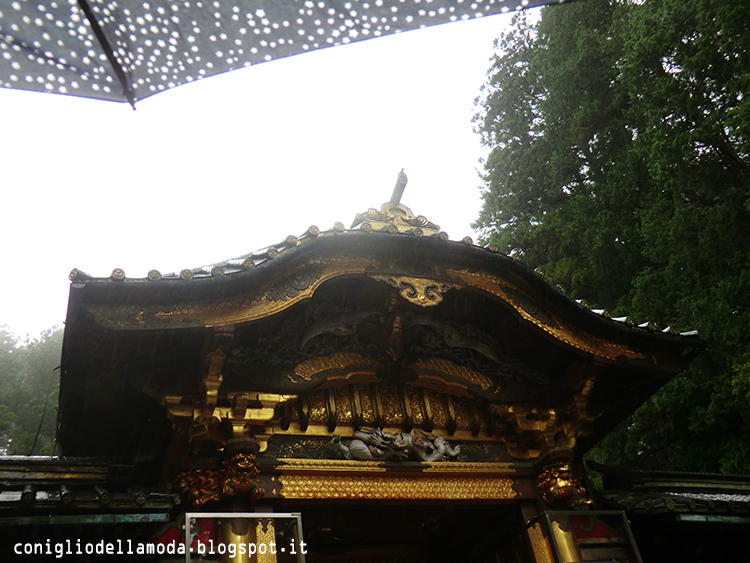
Dopo mangiato diluvia ancora. Attraverso il portale Omote-mon entriamo nel tempio Toshogu (ingresso con accesso al mausoleo 1300¥), il più famoso di Nikko. E' un santuario shintoista costruito nel VII secolo in onore di Tokugawa Ieyasu, il fondatore dello shogunato che governò il Giappone fino al 1868.
Il tempio è costituito da una serie di stupendi edifici riccamente decorati e circondato da altissimi alberi secolari.

After lunch it pours again. Through the Omote-mon portal we enter Toshogu (entrance with access to the mausoleum 1300¥), Nikko's most famous temple. It's a Shinto shrine built in the seventh century to honor Tokugawa Ieyasu, the founder of the shogunate that ruled Japan until 1868.
The temple consists of a series of beautiful richly decorated buildings surrounded by tall trees.

A sinistra c'è una pagoda a cinque piani risalente al 1650 (ma ricostruita nel 1818). La sua particolarità è che non ha fondamenta, ma contiene un lungo palo sospeso che, in caso di terremoto, oscilla come un pendolo per mantenere l'equilibrio.

To the left there is a five-storey pagoda dating back to 1650 (and rebuilt in 1818). Its peculiarity is that it has no foundations, but contains a suspended long pole that, in case of an earthquake, swings like a pendulum to keep the balance.

Appena dentro ci sono i Sanjinko, i tre sacri depositi, famosi per i rilievi di elefanti fatti da un artista che evidentemente non li aveva mai visti. Sono divertentissimi, gli elefanti hanno criniere, proboscidi bizzarre e quant'altro.
Ma l'edificio più famoso del complesso è Shinyōsha, la stalla Sacra, decorata con rilievi di scimmie, tra cui le tre famose scimmie sagge che con le mani si tappano gli occhi, le orecchie e la bocca ("Mizaru", "Kikazaru", "Iwazaru": "non vedere il male", "non sentire il male", "non parlare del male").
Attraversando un altro torii, sulla sinistra, c'è una famosa sala conosciuta per il dipinto sul soffitto, chiamato Nakiryū (drago che piange) a causa delle proprietà acustiche di questo spazio. Un monaco caciarone che sembra un venditore di auto usate ce ne dà una dimostrazione battendo insieme due bastoni. Il drago 'piange', quando i bastoni sono sotto la sua bocca, ma non altrove. Dopodiché il monaco prova a vendere al suo pubblico dei costosissimi talismani.

Once inside there are the Sanjinko, the three sacred deposits, famous for their elephants reliefs made by an artist that evidently had never seen one. They're fun, these elephants have manes, bizarre trunks and so on.
But the most famous building of the complex is Shinyōsha, the sacred stable, decorated with reliefs of monkeys, including the famous three wise monkeys that with over their eyes, ears and mouth ("Mizaru", "Kikazaru "," Iwazaru ": "see no evil ", "hear no evil ", "say no evil").
Through another torii, on the left, there is a famous hall known for the painting on the ceiling, called Nakiryū (crying dragon) because of the acoustic properties of the space. A monk that looks like a used car salesman gives us a demonstration by beating two sticks together. The dragon 'weeps' only when the sticks are below its mouth, but not elsewhere. After it the monk tryes to sell very expensive talismans to his audience.

Vediamo anche il decoratissimo portale Yomei-mon (porta del sole). Preoccupandosi che la sua perfezione potesse suscitare l'invidia negli dei, i costruttori misero apposta l'ultimo pilastro di sostegno a testa in giù. Una delle sue decorazioni è il famoso Nemuri-Neko, un piccolo bassorilievo di un gatto addormentato diventato celebre per il suo aspetto realistico. Da qui parte una serie di faticosissime scale fiancheggiate da cedri secolari che portano all'urna di bronzo in cui sono conservati i resti di Ieyasu.

We also see the highly decorated Yomei-mon portal (gate of the sun). Worrying that his perfection could arouse the envy of the gods, the builders put on purpose the last support pillar upside down. One of its decoration is the famous Nemuri-Neko, a small bas-relief of a sleeping cat that became well known for its realism. From here a series of exhausting stairs lined with cedar trees lead to the bronze urn in which there are Ieyasu remains.

Andando avanti c'è il Mausoleo Taiyuin (ingresso 200¥), fondato 16 anni dopo il completamento del Toshogu nel 1636. E' la tomba del terzo shogun Tokugawa, Tokugawa Iemitsu, il cui motto era "vivere una vita semplice". È insolito in quanto è sia un tempio buddista sia un mausoleo. Somiglia ad una versione più piccola del Toshogu.  Ovviamente la famosa porta Nio-mon è in ristrutturazione, ma per compensare è aperta la camera interna del tempio, che di solito i visitatori non possono vedere. Sul soffitto della sala principale, sono dipinti 140 draghi nell'atto di portare preghiere (simboleggiate da perle) al cielo, o di tornare dal cielo per prenderne altre. C'è anche l'armatura di Iemitsu.

Going forward there is Taiyuin Mausoleum (entry 200¥), founded 16 years after the completion of Toshogu in 1636. it's the tomb of the third Tokugawa shogun, Tokugawa Iemitsu, whose motto was "live a simple life". It is unusual because it is both a Buddhist temple and a mausoleum. It resembles a smaller version of the Toshogu. Obviously the famous Nio-mon portal is under restoration, but to compensate is open the inner chamber of the temple, which usually visitors can't see. On the ceiling of the main room, they are 140 painted dragons in the act of bringing prayers (symbolized by pearls) to heaven, or to return from heaven to take other. There is also Iemitsu's armor.

Abbiamo finito di visitare i bellissimi templi di Nikko. Per fortuna erano vicini, quindi siamo riusciti a vederli tutti e non ci siamo mai persi, altro che Kamakura! In compenso ci rendiamo conto di aver saltato il famosissimo ponte Shinkyo (detto "Ponte Sacro"), che era all'inizio del percorso, vicino al tempio Rinnoji. Così prendiamo l'autobus e scendiamo una fermata prima della stazione, arrivando a destinazione.
Questo bellissimo ponte rosso (laccato di questo colore solo nel 1636) fino al 1973 poteva essere usato solo dall’imperatore. Adesso per 300¥ tutti possono attraversarlo, ma... non porta da nessuna parte, si può fare solo avanti e indietro. Quando arriviamo noi la biglietteria è già chiusa, in compenso la luce del crepuscolo e le lanterne illuminate lo rendono particolarmente romantico.
Quella che si è vede oggi è una ricostruzione di inizio '900, su modello del ponte del 1636, perché l'originale è stato spazzato via da una piena. Al ponte  Shinkyo è legata una leggenda: il monaco Shodo e i suoi discepoli volevano scalare il monte Nantai, tuttavia non riuscivano ad attraversare il fiume Daiya. Shodo iniziò a pregare e apparve Jinja-Daiou, il dio dei serpenti, con due serpenti attorcigliati intorno al braccio destro che si trasformarono in una sorta di ponte permettendo a ai monaci di attraversare il fiume.

We end our visit to the beautiful temples of Nikko. Luckily they were close, so we got to see them all and we never got lost, nothing like Kamakura! On the other hand, we realize wemissed the famous Shinkyo bridge (called "Sacred Bridge"), which was at the beginning of the trail, near the Rinnoji temple. So we take the bus and get off one stop before the station, arriving at our destination.
This beautiful red bridge (painted this color only in 1636) until 1973 could be used only by the emperor. Now for 300¥ everyone can cross it, but... it doesn't lead anywhere, you can walk just back and forth. When we arrive, the ticket office is already closed, in return, the twilight and the light of the lanterns make it particularly romantic.
What you can see today is an early '900 reconstruction, on the model of the 1636 bridge, because the original was washed away by a flood. Shinkyo bridge is connected to a legend: monk Shodo and his disciples wanted to climb Mount Nantai, but they could not cross river Daiya. Shodo started praying and Jinja-Daiou, the god of snakes, appeared with two serpents entwined around his right arm that turned into a kind of bridge allowing the monks to cross the river.

Per vedere il ponte perdiamo il penultimo treno e, anche se ne è valsa senz'altro la pena, dobbiamo aspettare l'ultimo per quasi un'ora. Fra l'attesa e il viaggio, arriviamo a Tokyo tardissimo, per fortuna siamo già ad Asakusa, il quartiere del nostro hotel. Però i ristoranti che volevamo provare sono già tutti chiusi. Scelgo a caso un locale specializzato in anguilla che è anche un hotel. E' caro, ma non ho voglia di cercare un altro posto e l'anguilla mi fa gola, in più gli avventori tutti giapponesi mi danno sicurezza. Il ristorante propone vari piatti a base di anguilla, fra cui addirittura un menù che permette di mangiarla tutta, dai crackers fatti con le ossa alle interiora. Noi non siamo così coraggiosi e optiamo per il classico unaju (2720¥), anguilla servita su di un letto di riso in una scatola laccata. Insieme ci vengono serviti dei sottaceti e una zuppa pepata, con dentro qualcosa di strano, che si rivela essere... interiora di anguilla! Per fortuna non lo sapevo prima di mangiarle! A parte la sorpresa, non mi piacciono granché. L'anguilla invece è molto buona e particolare: ha il caratteristico sapore dato dalla cottura su carbone e non è affatto dolciastra come quelle che ho mangiato in Italia e a Kyoto.

To see the bridge we lose the second to last train and, even if it was worth definately worth it, we have to wait for the last for nearly an hour. Between waiting and traveling, we arrive in Tokyo late, fortunately we are already in Asakusa, our hotel's neighborhood. But the restaurants we wanted to try are already all closed. I choose at random a place specializing in eel that is also a hotel. It's expensive, but I don't want to look for another place and I'm craving for eel, plus the costumers are all Japanese, and it comforts me. The restaurant offers various eel dishes, including even a menu that allows you to eat it all, from bones crackers to the intestines. We are not so brave and choose the classic unaju (2,720¥), eel served on a bed of rice in a lacquered box. With it came also pickles and a and peppered soup with something strange inside, which turns out to be... eel innards! Luckily I did not know it before eating them! Apart from the surprise, I do not like them much. The eel is very good and rather particular: it has the characteristic flavor given by cooking on charcoal and it isn't at all sweet like the ones I ate in Italy and Kyoto.

Japan travel journal 6/9/15: Nikko


venerdì 2 ottobre 2015

Un sacco di lavoretti/A lot of small crafts

In questo post raccolgo tutti quei lavoretti che ho fatto ultimamente a cui non vale la pena di dedicare un post vero e proprio.
Ho trasformato i pendenti per cuffie di Sailor Mars che mi aveva regalato la mia amica V-chan in orecchini veri e propri.

In this post I collect all those crafts that I have done lately that aren't worth a full post.
I turned the Sailor Mars headphones pendants my friend V-chan gave me in real earrings.

Ho fatto un altro paio di orecchini con le nappine comprate in Giappone. Le perle bianche e nere stanno bene con tutto, ma penso che in seguito le sostituirò, mi piacerebbe qualcosa di più luccicante e decorato, sempre a buco grande, che però al momento non possiedo.

I made another pair of earrings with the tassels I bought in Japan. The white and black beads are easy to coordinate with everything, but I think I will replace them later, I'd like something more sparkly and decorated, with a big hole, that I don't currently possess.

Ho fatto altre due collane con la tecnica del cordino tubolare.

I made two necklaces with the ribbon to cord technique.

Per il compleanno di mio suocero gli ho fatto una custodia per kindle quasi identica a quella che avevo fatto per mia madre (trovate il tutorial qui).

For my father in law's birthday I made a kindle cover almost identical to the one I made for my mother (you can find the tutorial here).

Ho infilato un ciondolo che mi ha passato mia madre in un cordino rosso da legare intorno al collo. Non è proprio qualcosa che userò tutti i giorni, ma d'altronde anche il ciondolo non è esattamente sobrio (il fatto che sia da una parte leone e dall'altra bussola mi piace tantissimo).

I added a red ribbon to a pendant that I my mother handed over to me to tie it around the neck. It's not really something that I will use every day, but the pendant is not exactly sober too (I love that it is on one side lion and on the other compass).

Ho anche preso la difficile decisione di togliere i campanellini che avevo cucito alle punte di questa gonna, in modo da poterla indossare più spesso.

I also made the difficult decision to remove the bells that I sewes to the points of this skirt, to make it suitable to be worn more often.
Related Posts Plugin for WordPress, Blogger...